I filmed it on my tablet, which took a little getting used to, but after a couple of takes, I think I got the hang of it.
Showing posts with label lammas. Show all posts
Showing posts with label lammas. Show all posts
Monday
August 17th, 2015
After something like three years, I finally made another video for my YouTube channel! Sooner or later, I'd love to start doing how-to videos, or segments on crystals and similar, but today I just walked viewers through my Lughnasadh altar.
I filmed it on my tablet, which took a little getting used to, but after a couple of takes, I think I got the hang of it.
I filmed it on my tablet, which took a little getting used to, but after a couple of takes, I think I got the hang of it.

Thursday
O hí Lughnasadh
I haven't done an actual Lughnasadh ritual in at least four years because I'm always spending the weekend at Fairy Fest. This year, however, with Destiny coming over, we're planning to do something in the evening. As such, I figured I ought to get my altar set up ahead of time.

I rather like this design. I might edit it a little still before next week, but I think I've got a nice, solid foundation.


I rather like this design. I might edit it a little still before next week, but I think I've got a nice, solid foundation.
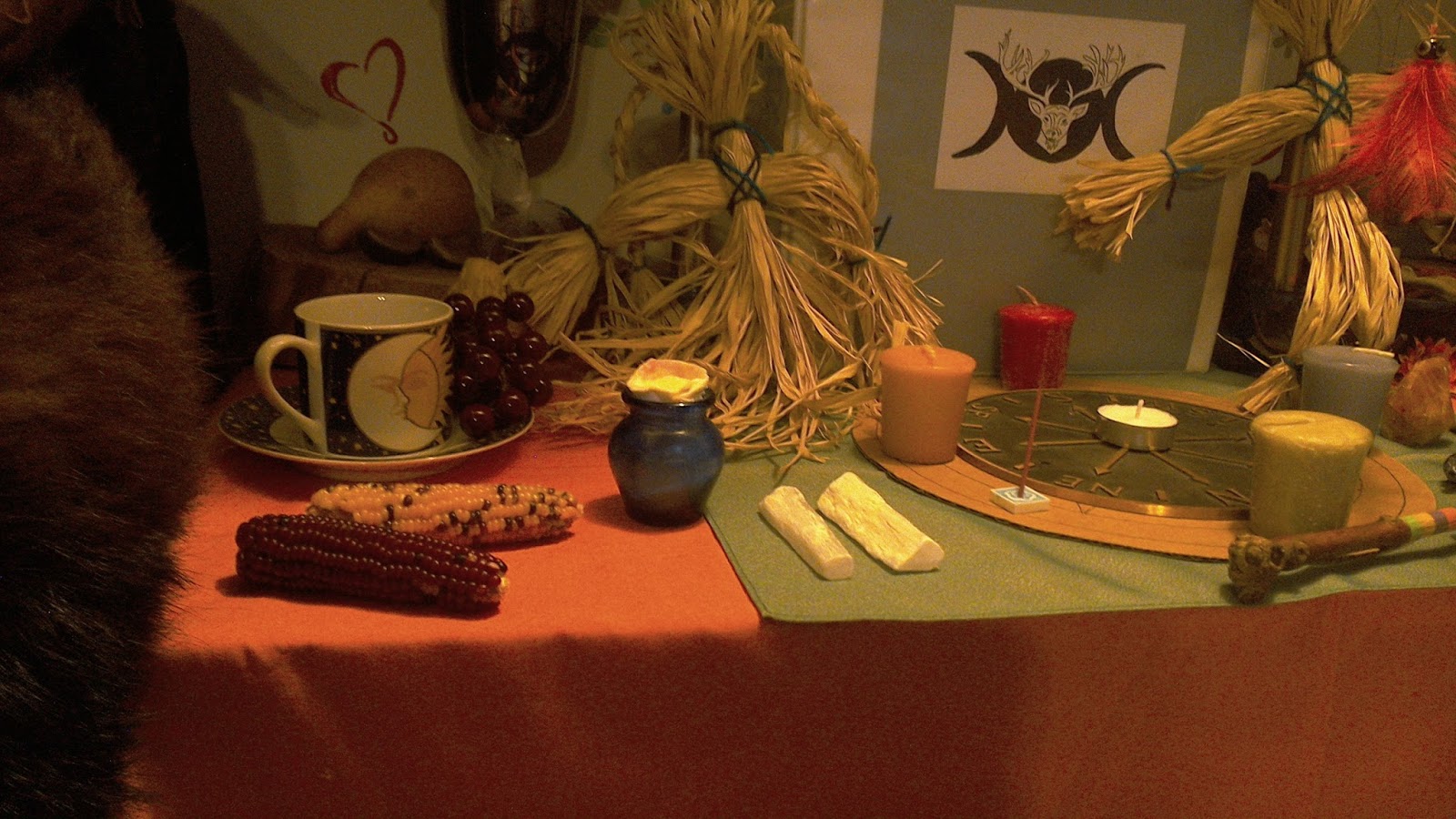
On the left, I have my chalice, gourds, (plastic) grapes, a cup and saucer for water, salt, and a pair of dried corn cobs. I also have a "corn dolly" goddess figure (actually made out of taffeta) which I put together several years ago.
In the center, I've my elemental candles all sitting around the direction plate I got at the auction last month. In the center is the tea light from Rebekka, as well as a tiny incense holder and my new Selenite wands.

Over on the right side of the altar, there's a god figure to match the goddess one, as well as my wand, athame, and a feather. There are more gourds and grapes, and I filled my cauldron with some festive potpourri I found. A seasonal fairy hangs in the back, and up front sit pieces of Orange Calcite, Citrine, and a crystal which I've finally identified as Aragonite.
All of this is sitting on an orange tablecloth with a smaller green swatch in the center. The orange is one which I've generally reserved for Samhain in the past, but I decided that I might as well use it since I likely won't even be here for Samhain, and I wanted some more color. The green is actually a piece I got in Japan during a high school calligraphy class. Hidden under my elemental items is the Japanese kanji for "festival"; it's really just as well that it's hidden, because I didn't do the neatest job of writing it. C'est la vie.
Still not entirely sure what our ritual is going to consist of - I'll continue researching that this evening - but I'm excited!
Monday
August 6th, 2012
After leaving for Hazelnut's house Friday afternoon, I returned yesterday around 7:00. On Friday, I got acquainted with Hazelnut's new familiar, Gypsy, a black kitten who they found abandoned in a park. She's absolutely adorable, although her wee little claws sure are sharp! We also made meringue cookies, some of which we decided to take on Saturday to share. Saturday morning, we stopped at a Subway restaurant to get lunch, already in our costumes. The expression on the employee's face was priceless. Then we drove to the festival park, getting there early to sign in as volunteers.


There wasn't a great deal for us to help with, so instead, we spent the day exploring the vendor's tents, watching the Swords of Valour perform their sword fights - they're quite a hilarious group, actually - and spending a large portion of the money we brought. It will never cease to amaze me how blatantly Pagan the Faery Fest is: it seemed like everyone had a pentacle necklace, a Triple Goddess tattoo, a dancing Goddess necklace, or some combination of the three. And even those who didn't often reflected one or more of the themes in their wares.


We found a vendor from OakMoon Crafts selling beautiful sets of embroidered towels, wash cloths, Books of Shadows, shirts, and more, with the embroidery including fantasy dragons and faeries for non-Pagans, and pentacles, Sabbat imagery, and Triple Goddess signs for those who were. I was really tempted to take home a Lammas washcloth, but somehow I wasn't sure that my parents would approve. That was only the tip of the proverbial iceberg, though. One huge tent had a vast variety of goods, ranging from fox and raccoon tails to delicate beaded jewelry. Hazelnut found a perfect ceramic cauldron for $3, as well as a lovely brass chalice. I got myself a pouch to hold stones and herbs in. Speaking of stones, there were at least three places specializing in semi-precious varieties, which I took a particular interest in exploring. I ended up with a piece of emerald calcite and fluorite. Also on day one, I purchased a small besom, as my previous one was... lacking, to put it kindly, as well as a snail-shell water vial. We chased giant bubbles around for a while, enjoyed some wonderful music, and were about to head around again when a huge storm blew in, closing the Fest a few hours early. In the meantime, Hazelnut and I headed back to her house, where we relaxed for the evening. Sunday morning, it was back to the Faery Fest. Because of Saturday's storm, some of the vendors had had trouble with their tents, so Hazelnut and I helped get things in order. We also gave Meadowynn and the Faery Queen a hand with the tea parties, where little faery girls could listen to stories, eat some cookies, and enjoy blueberry lemonade. Later, I had a chance to hit up some more stone vendors, and used the last of my cash on pieces of unakite, red jasper, malachite, sodalite, and bloodstone. Finally, may I just say that some of the costumes we saw were spectacular. There were whole hosts of faeries, Green Men, pirates, and other sprite-ly beings who had really gone all out.


There wasn't a great deal for us to help with, so instead, we spent the day exploring the vendor's tents, watching the Swords of Valour perform their sword fights - they're quite a hilarious group, actually - and spending a large portion of the money we brought. It will never cease to amaze me how blatantly Pagan the Faery Fest is: it seemed like everyone had a pentacle necklace, a Triple Goddess tattoo, a dancing Goddess necklace, or some combination of the three. And even those who didn't often reflected one or more of the themes in their wares.


We found a vendor from OakMoon Crafts selling beautiful sets of embroidered towels, wash cloths, Books of Shadows, shirts, and more, with the embroidery including fantasy dragons and faeries for non-Pagans, and pentacles, Sabbat imagery, and Triple Goddess signs for those who were. I was really tempted to take home a Lammas washcloth, but somehow I wasn't sure that my parents would approve. That was only the tip of the proverbial iceberg, though. One huge tent had a vast variety of goods, ranging from fox and raccoon tails to delicate beaded jewelry. Hazelnut found a perfect ceramic cauldron for $3, as well as a lovely brass chalice. I got myself a pouch to hold stones and herbs in. Speaking of stones, there were at least three places specializing in semi-precious varieties, which I took a particular interest in exploring. I ended up with a piece of emerald calcite and fluorite. Also on day one, I purchased a small besom, as my previous one was... lacking, to put it kindly, as well as a snail-shell water vial. We chased giant
 bubbles around for a while, enjoyed some wonderful music, and were about to head around again when a huge storm blew in, closing the Fest a few hours early. In the meantime, Hazelnut and I headed back to her house, where we relaxed for the evening. Sunday morning, it was back to the Faery Fest. Because of Saturday's storm, some of the vendors had had trouble with their tents, so Hazelnut and I helped get things in order. We also gave Meadowynn and the Faery Queen a hand with the tea parties, where little faery girls could listen to stories, eat some cookies, and enjoy blueberry lemonade. Later, I had a chance to hit up some more stone vendors, and used the last of my cash on pieces of unakite, red jasper, malachite, sodalite, and bloodstone. Finally, may I just say that some of the costumes we saw were spectacular. There were whole hosts of faeries, Green Men, pirates, and other sprite-ly beings who had really gone all out.
Wednesday
Lammas Altar
My video of this year's Lammas altar, featuring a hand-knit altar cloth, some brand-new candles, and many seasonal decorations that make for a simple, but elegant altar setting.
Lammas Bread and Protection Spell

~~~~~~~~~~
Ingredients:
- 2 cups whole wheat flour
- 2 cups bread flour (have some extra on hand)
- 1/4 cup sesame seeds (toasted)
- 2 tbsp active dry yeast
- 2 1/2 tsp salt
- 2 cups "scalded" milk (heated to almost boiling)
- 3 tbsp smooth peanut butter
- 3 tbsp honey
- 1 tbsp vegetable oil
~~~~~~~~~~
Directions:
In a large bowl, mix the dry ingredients. Add the peanut butter and honey to the hot milk and stir until combined. Allow liquid to cool to 115 °F, then stir into flour mixture. Knead gently for 15 minutes, adding some of that extra bread flour until a smooth, elastic dough is achieved. Lightly wipe with vegetable oil, cover with a damp towel or plastic wrap, and allow to rise in a warm spot until dough size has doubled. This step may take several hours, so be patient. Then, punch down the dough (gently, again - food doesn't respond well to violence). Shape into two loaves, and let rise again until doubled. Bake at 375 °F until golden brown and delicious.
Once cooled, take one of the loaves and break into quarters. Step outside the home, and, beginning at the North or Northeastern corner of the building, set down one of the bread pieces. Recite a blessing of protection. A simple version is:
I call on the spirits
Of north, and south, east and west
Protect this place
Use your creativity. Leave the bread for the local wildlife, and continue around the house, repeating the procedure at the four corners of the property. Then enjoy the other loaf!
Extras:
While I am certainly no expert on the subject, bread can be baked in a vast variety of designs and shapes. If one appeals to you in particular, and especially if it reflects a theme of Lammas, go for it! The bread can also be baked in a wreath shape. Holes are cut in the bread, and candles can be inserted. Consider using 12 candles, for the wheel of the year. They don't have to be large; even tea lights in a sturdy glass container will do nicely. Or, just leave the bread in traditional loaves. It's your call.
Recipe/spell from here.
~~~~~~~~~~
Protection Spell:Once cooled, take one of the loaves and break into quarters. Step outside the home, and, beginning at the North or Northeastern corner of the building, set down one of the bread pieces. Recite a blessing of protection. A simple version is:
I call on the spirits
Of north, and south, east and west
Protect this place
Use your creativity. Leave the bread for the local wildlife, and continue around the house, repeating the procedure at the four corners of the property. Then enjoy the other loaf!
Extras:
While I am certainly no expert on the subject, bread can be baked in a vast variety of designs and shapes. If one appeals to you in particular, and especially if it reflects a theme of Lammas, go for it! The bread can also be baked in a wreath shape. Holes are cut in the bread, and candles can be inserted. Consider using 12 candles, for the wheel of the year. They don't have to be large; even tea lights in a sturdy glass container will do nicely. Or, just leave the bread in traditional loaves. It's your call.
Recipe/spell from here.
August 1st, 2012
A very happy Lammas to everyone! I'm celebrating today with some self-pampering, a nice ritual, and, of course, some great food. Lammas, after all, is in celebration of the beginning of the harvest season.
I've been busy as a bee-bird* the last few days, getting ready to go to Hazelnut's house on Friday. Besides the fact that we just plain have fun together, we are going to go to the Fairy Fest, or "World of Faeries", as the event is also known. We will dress up, me as a water fairy, and Hazelnut as a fire fairy. Dresses, gemstones, glitter - it'll be pretty awesome, if I do say so myself. I believe we're also going on Sunday. I'm super excited; I had to miss it last year due to a family reunion. Definitely taking some pictures to share!
*This was a play on words: "bee-bird" is the literal translation of the word for "hummingbird" in Japanese (hachidori). And now it's a lot less funny since I had to explain it. ;)

I've been busy as a bee-bird* the last few days, getting ready to go to Hazelnut's house on Friday. Besides the fact that we just plain have fun together, we are going to go to the Fairy Fest, or "World of Faeries", as the event is also known. We will dress up, me as a water fairy, and Hazelnut as a fire fairy. Dresses, gemstones, glitter - it'll be pretty awesome, if I do say so myself. I believe we're also going on Sunday. I'm super excited; I had to miss it last year due to a family reunion. Definitely taking some pictures to share!
*This was a play on words: "bee-bird" is the literal translation of the word for "hummingbird" in Japanese (hachidori). And now it's a lot less funny since I had to explain it. ;)

Sunday
July 8th, 2012
For the past month on the Celtic calendar, the tree of note has been the Oak. Today, however, is the first of the Holly month. Personally, I find this a significant representation of the Oak and Holly King story, as the Holly King cast down his twin not long ago, at midsummer. The Holly month, called Tinne by the Celts, is a time of masculine energy.
 Holly, or Ilex, is a genus of 400 to 600 species of flowering shrubs. The genus is spread worldwide, in evergreen and deciduous forms, both in the tropics and in temperate climates. Holly flowers are small and white, usually with four petals. Unlike many species, the members of the Holly genus typically have distinct male and female flowers, which grow on separate plants (there are exceptions, however). Pollination occurs through bees and other insects. The fruits of the Holly, typically called berries, are actually drupes, and ripen in the winter. Because the drupes are available when most food is scarce, the Holly is an important source of food and shelter for many birds and animals.
Mythologically speaking, Holly was considered by the Druids a gift to keep the earth beautiful when the sacred Oak lost its leaves. It was also associated with the aforementioned Holly King, the patron of the Winter Solstice festivals. Later, the Romans hailed Holly as being sacred to Saturn, and so used the plant to decorate images of Saturn and as a method of honoring him during the festival of Saturnalia. Centuries later, early Christians avoided Roman persecution in their Christmas rites by using the Saturnalia Holly. Hence, Holly was adopted into Christian tradition as well. In European lore, although boughs of Holly could be taken for decoration, and the berries used for animal feed, to cut down an entire tree/shrub was considered bad luck. Some people went out of their way to avoid hurting the trees, and believed that they had protective qualities. The Holly was believed to keep houses from being struck by lightning, and was cultivated as a protective barrier. As such, it became associated with thunder gods, like the Norse Thor. Interestingly, modern science has shown this ancient legend to hold some ground - the distinctive shape of the Holly leaves and spines act as a sort of natural lightning conductor, protecting the Holly itself, as well as nearby objects.
In magick, use Holly to access masculine energy, and consider carving masculine tools (an athame handle, wand, etc.) out of Holly. In related fashion, some traditions hold that a proper athame ought to be consecrated with holly incense. Its protective properties remain relevant also; hanging a Holly bough in the home will bring good luck and safety. Holly can be worn as a protective charm, and soaking Holly in moon-bathed water for several hours will create Holly water, which when sprinkled around people acts as a blessing, and when sprinkled in the home acts as a cleanser. Holly is associated with the cycle of life, death, and rebirth, and can be used in a Lammas ceremony as easily as in one meant for Yule. It can help people cope with death, and brings calm, sweet dreams.
Holly is not known for being edible - indeed, eating the berries can cause vomiting and diarrhea. The plant is considered toxic to humans and should not be ingested.

Mythologically speaking, Holly was considered by the Druids a gift to keep the earth beautiful when the sacred Oak lost its leaves. It was also associated with the aforementioned Holly King, the patron of the Winter Solstice festivals. Later, the Romans hailed Holly as being sacred to Saturn, and so used the plant to decorate images of Saturn and as a method of honoring him during the festival of Saturnalia. Centuries later, early Christians avoided Roman persecution in their Christmas rites by using the Saturnalia Holly. Hence, Holly was adopted into Christian tradition as well. In European lore, although boughs of Holly could be taken for decoration, and the berries used for animal feed, to cut down an entire tree/shrub was considered bad luck. Some people went out of their way to avoid hurting the trees, and believed that they had protective qualities. The Holly was believed to keep houses from being struck by lightning, and was cultivated as a protective barrier. As such, it became associated with thunder gods, like the Norse Thor. Interestingly, modern science has shown this ancient legend to hold some ground - the distinctive shape of the Holly leaves and spines act as a sort of natural lightning conductor, protecting the Holly itself, as well as nearby objects.
In magick, use Holly to access masculine energy, and consider carving masculine tools (an athame handle, wand, etc.) out of Holly. In related fashion, some traditions hold that a proper athame ought to be consecrated with holly incense. Its protective properties remain relevant also; hanging a Holly bough in the home will bring good luck and safety. Holly can be worn as a protective charm, and soaking Holly in moon-bathed water for several hours will create Holly water, which when sprinkled around people acts as a blessing, and when sprinkled in the home acts as a cleanser. Holly is associated with the cycle of life, death, and rebirth, and can be used in a Lammas ceremony as easily as in one meant for Yule. It can help people cope with death, and brings calm, sweet dreams.
Holly is not known for being edible - indeed, eating the berries can cause vomiting and diarrhea. The plant is considered toxic to humans and should not be ingested.
Thursday
Corn Dolly
How many of you ate corn on the cob for the 4th of July yesterday? Come on, raise those hands... I know I did, and as such, I had a big bag full of leftover corn husks afterwards. Why waste those precious husks on the garbage can? A compost bin is a good place to begin, but a good number of those husks can be saved and turned into corn dollies, which make great decorations for Lammas, Mabon, and even Imbolc! So go on, grab a hand-full of them. I'd recommend having 20 or so on hand, per dolly. You probably won't use all of them, but having extra is better than not enough. If you didn't happen to have any corn on the cob last night, it's okay. Most megamarts carry dried corn husks that can be used instead - just soak them in some water for about a half-hour first. You will also want a pair of scissors, some cotton balls (two or three per dolly), and a skein of yarn. I chose red, but the color is really up to you.
Head:
 Arms:
Arms:

Skirt:
 Extras:
At this point, it's up to you. You could use some yarn, leftover husks, raffia, or other material to give her hair. Using glue and some beads, or just a marker, you can add a face. A poncho-style dress is easily made by taking a length of fabric twice as long as the body, folding it in half, and cutting out a circle for the head. Slide the fabric over the head, and consider tying off with ribbon or more yarn. Or, just leave the dolly as-is. You be the judge.

Head:
- Take a single husk and place a cotton ball or two in the middle.
- Fold the husk in half and twist around the cotton balls to form the head.
- Tie in place with yarn.

- Take two or three corn husks, and lay them on top of each other. Fold in half, and then in half again.
- Tie off both ends of the husks with yarn to make the arms.
- Slide the arms between the front and back flaps of the head piece. Tie in place with yarn, wrapping around several times.

Skirt:
- Begin layering husks around the waist of the corn doll, pointing up. Yes, that's right - it ought to look like your corn dolly pulled a Marilyn Monroe.
- Once the skirt goes all the way around the doll, still flipped up, tie the husks to the torso tightly.
- Begin pulling the husks down over the top of the yarn, so that her skirt appears normal, and conveniently hides some of the yarn.

At this point, it's up to you. You could use some yarn, leftover husks, raffia, or other material to give her hair. Using glue and some beads, or just a marker, you can add a face. A poncho-style dress is easily made by taking a length of fabric twice as long as the body, folding it in half, and cutting out a circle for the head. Slide the fabric over the head, and consider tying off with ribbon or more yarn. Or, just leave the dolly as-is. You be the judge.

Monday
February 20th, 2012
Today, I checked out (among other things) a book called Rupert's Tales from the library. It is a precious story about Rupert the rabbit who
"...sets out to discover how and why people leave their homes to celebrate seasonal holidays in the forest where he lives."
 The book is by a woman who goes by Kyrja, and essentially explains the meaning behind Beltane, Litha, Lammas, and Mabon through the eyes of a rabbit. It is aimed at younger readers, but even I, as a high-schooler, was enchanted simply by the novelty of finding a Pagan picture book. I haven't finished it yet (it's quite long for a picture book!), but the Beltane story was simply adorable, and... I don't know... is magick in its own right. Somehow you can't not feel warm and fuzzy reading it, even if you are familiar with the meaning behind the Sabbats. I'd highly recommend it to anyone and everyone, but particularly if you have Pagan children!

"...sets out to discover how and why people leave their homes to celebrate seasonal holidays in the forest where he lives."
 The book is by a woman who goes by Kyrja, and essentially explains the meaning behind Beltane, Litha, Lammas, and Mabon through the eyes of a rabbit. It is aimed at younger readers, but even I, as a high-schooler, was enchanted simply by the novelty of finding a Pagan picture book. I haven't finished it yet (it's quite long for a picture book!), but the Beltane story was simply adorable, and... I don't know... is magick in its own right. Somehow you can't not feel warm and fuzzy reading it, even if you are familiar with the meaning behind the Sabbats. I'd highly recommend it to anyone and everyone, but particularly if you have Pagan children!
Saturday
February 18th, 2012
 Today begins the Celtic Tree Month of Ash, or Nion. The tree belongs to the Fraxinus genus, which includes 45 - 65 species, and is actually classified in the same family as Olive trees and Lilacs. While most species are deciduous, some subtropical species are evergreen. Ash trees produce samara fruit, the ever-popular "helicopter seeds".
One of the three trees sacred to the Celts, Ash is present in mythology throughout Europe. According to Norse Legend, the world-tree, or Yggdrasil, was Ash, as was Odin's spear. Further, the first man was born of an Ash tree. Elsewhere in Europe, Ash leaves (or circles drawn with Ash boughs) was said to repel snakes. Conversely, Irish folklore holds that the shadow of the tree is damaging to crops. The Greeks also included the Ash in their mythos, as the Meliae were nymphs of the Ash tree. Interestingly, there is a parallel between Greek legend and the Norse. It was said that the Meliae, who, as you recall, were spirits of the Ash tree, later created mankind, similar to Norse legend, where man was created from the Ash.
 Magickally speaking, Ash has many uses. The tree is actually sacred to the God Lugh, celebrated at Lammas (Lughnasadh), and because of its divine connection, it has long been believed that a tool, magickal or mundane, will be more productive when made of Ash than a tool made with any other wood. Therefore, Ash can be used in ritual to increase magickal potency. However, be careful when collecting Ash wood, as those who disrespect the trees frequently find themselves in with a bout of supernatural consequences. The tree is further associated with spiritual journeys and prophetic dreams, as well as divination, making Nion a particularly good time to do magick for personal introspection. European folklore dictates that an ash leaf will remove skin disorders, such as boils and warts, and other folk magick calls for carrying an Ash leaf in the pocket to ensure good fortune.
Unfortunately, I cannot seem to find conclusive information over the internet whether or not the Ash is poisonous. If someone has any information about this, please contact me. In the meantime, I recommend not inhaling the smoke of the tree, nor do I recommend ingesting it in any way.
Sunday
November 6th, 2011
While my mom and dad don't really mind my religious choice, they still expect me to go with them to church and to participate and whatnot. As such, I have been helping with the preschoolers' Sunday School. Today, the craft we did was so Pagan I couldn't help but smile to myself. The kids made shakers out of two paper bowls filled with grains (corn, rice, and barley) and then decorated the outside with a printed-and-cut-out picture of a woman holding grains. She was supposed to be Ruth or something from the Bible, but all I could think was the Goddess at Lammas. Obviously, it's a little late in the season for harvest activities, but come next Mabon or Lammas, this could be a really cute craft for Pagan kids. They sound a lot like rainsticks when shaken, so one could even devise a small, kid-friendly ritual where you make these shakers and shake them to "rain" abundance (symbolized by the grain) on the household. It also gives the little ones fun instruments to use in ritual that won't break the bank to replace if something were to happen to them.
In other news, I want to decorate my altar for Yule today, after I finish this post and get off the computer. Pictures, anyone?
In other news, I want to decorate my altar for Yule today, after I finish this post and get off the computer. Pictures, anyone?
Subscribe to:
Posts (Atom)