Welcome

Merry Meet, all. Hummingbird, here. 21-year-old eclectic Pagan and witch who works primarily in crystal, warding, and energy magicks. Asexual, with a wonderful girlfriend. I am just beginning to learn the path of Athena. Attending college with end goal of a degree in Interior Design.

This blog is a digitalized record of my life as a Pagan. It includes spells, charms, notes on the properties of various magickal items, and my own personal experiences with my practice. Sometimes I post multiple times a day, sometimes it's once a month.

All are welcome here. Please, make yourself at home, and let me know if I can help you with anything. )0(
Showing posts with label wand. Show all posts

Sunday

October 11th, 2015

What an idyllic October day! It was in the mid-70's here today, and I got to go apple picking with my family. We saw a coyote on the drive up to the orchard, as well as a pheasant, which I don't think I've ever seen in the wild before.


The orchard was beautiful, and the Empire apples had just come into season; they're our absolute favorite, and we got a lot of good ones. 


We also picked Jonafree, Liberty, Ultra Gold, and Cortland.


The orchard also has a pumpkin patch, as well as raspberries, melons, and more. In the past, they've had fantastic deals on their produce, but I think we came too early for that this year, so we didn't get a ton of gourds or anything, although dad did pick up a turban squash.


While we were there, I also found a perfectly straight apple-wood stick and a bunch of guinea fowl feathers. I'm going to turn them into a new wand!

Thursday

O hí Lughnasadh

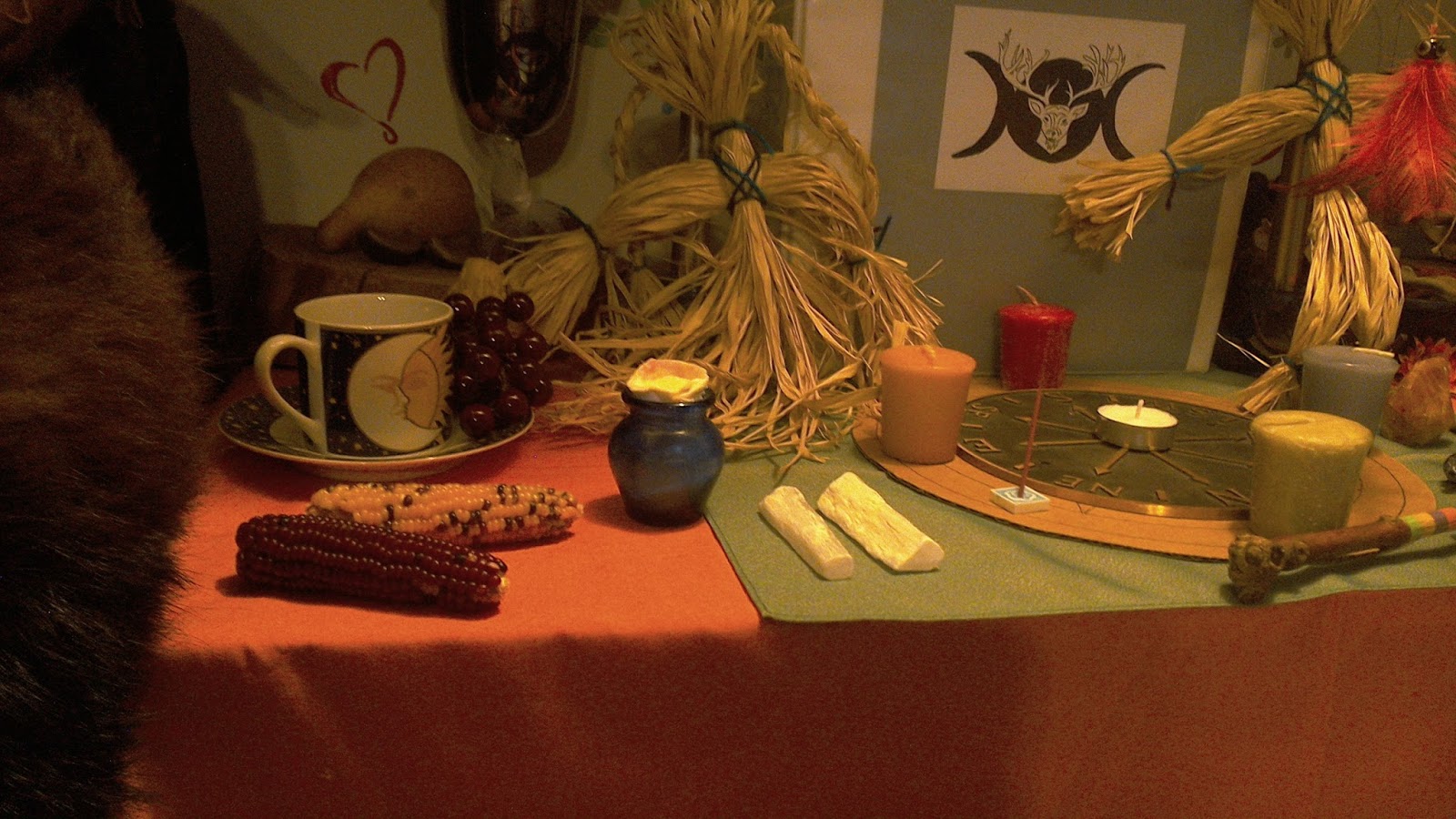
I haven't done an actual Lughnasadh ritual in at least four years because I'm always spending the weekend at Fairy Fest. This year, however, with Destiny coming over, we're planning to do something in the evening. As such, I figured I ought to get my altar set up ahead of time.


I rather like this design. I might edit it a little still before next week, but I think I've got a nice, solid foundation.


On the left, I have my chalice, gourds, (plastic) grapes, a cup and saucer for water, salt, and a pair of dried corn cobs.  I also have a "corn dolly" goddess figure (actually made out of taffeta) which I put together several years ago. 

In the center, I've my elemental candles all sitting around the direction plate I got at the auction last month. In the center is the tea light from Rebekka, as well as a tiny incense holder and my new Selenite wands. 


Over on the right side of the altar, there's a god figure to match the goddess one, as well as my wand, athame, and a feather. There are more gourds and grapes, and I filled my cauldron with some festive potpourri I found. A seasonal fairy hangs in the back, and up front sit pieces of Orange Calcite, Citrine, and a crystal which I've finally identified as Aragonite. 

All of this is sitting on an orange tablecloth with a smaller green swatch in the center. The orange is one which I've generally reserved for Samhain in the past, but I decided that I might as well use it since I likely won't even be here for Samhain, and I wanted some more color. The green is actually a piece I got in Japan during a high school calligraphy class. Hidden under my elemental items is the Japanese kanji for "festival"; it's really just as well that it's hidden, because I didn't do the neatest job of writing it. C'est la vie.

Still not entirely sure what our ritual is going to consist of - I'll continue researching that this evening - but I'm excited!

Saturday

June 22nd, 2013

Well, I promised a post about Selenite, so I guess I'd best deliver, huh? I must admit, I was very excited when Grandma gave me that candle holder - I've been wanting a bit of Selenite for a while, and anything that will hold one of my numerous candles is a good thing!

Selenite


Physical Characteristics: Selenite is a crystalline form of Gypsum, often without imperfections. Though many specimens will have no inclusions to speak of, some Selenite can be found with really unusual inclusions, like fossils or liquid water - be aware that the properties of these will add to the stone's potential.

In Nature: This stone is an evaporite, forming in dried alkaline lake muds, clay beds, seas, salt flats, and caves. Specimens have been discovered dating back to the Silurian Period, making them about 443.7 million years old.

Chemical Composition: CaSO4 · 2H2O

Mohs Scale Hardness: 2 (very low)

Can be Found: Gypsums in general are very common, and can be found on all seven continents.

A Public Service Announcement: DO NOT cleanse Selenite in water. Because the chemical structure contains water, exposure to the liquid can cause the stone permanent damage.

Healing Properties*: In healing, the stone ensures the proper flow of bodily fluids (recall that Selenite is named for Selene, goddess of the Moon, and that the Moon causes the movement of bodies of water), including fluid in the spine. It aligns the spinal column and promotes flexibility. The stone may also guard against or reduce the severity of epileptic seizures. Selenite improves the body's capacity to absorb Calcium; if one is not properly assimilating vitamins and minerals, work a ritual with Selenite to correct the problem. It also protects women and unborn children during pregnancy.

Magickal Properties: Selenite is a stone of psychic communication, facilitating interaction with ancestors, deceased loved ones, spirit guides, and other higher beings. Use Selenite to boost telepathy, divinatory skill, and access to the Akashic Records. Professional mediums and clairvoyants may find the stone especially beneficial. As the stone's vibration is very fine, it brings clarity of the mind and opens the Crown Chakra. Use it to access higher consciousness. Selenite links with one's light body, helping to anchor it in earthly vibrations. Selenite is an effective cleanser and charger of other stones. Likewise, one can Lay it on the body or move it through the aura to balance the body's energy. The stone promotes dream recall and improves one's ability to access past life memories. Wands may be made of Selenite in a tabular crystal form; for example, I have seen Chakra Wands made with a Selenite base.

Chakra Association: The Sixth (Third Eye) and Seventh (Crown) Chakras are closely connected to Selenite, though the stone works with the others as well.

Element: Water

Energy: Projective

Planetary Association: Moon (I know it's not really a planet, but it's considered one in astrology.)

*Magickal healing should never take the place of seeing a doctor and following any recommended prescriptions, actions, or other advice. Magick works best in tandem with physical efforts, anyway, so don't skimp on those check-ups!

Thursday

May 9th, 2013

As of today, I have 8,888 pageviews. You guys make my day! :D
And, since they seem to be at least mildly popular, here's some more exposition on stones that I've bought - oops! Today's topic for discussion isn't a stone, it's a mineral - Copper!

Copper
 
Physical Characteristics: Copper is a metal with the atomic number 29. It is ductile and highly conductive, both of heat and electricity. Though it has an orange coloration to it, Copper corrodes with time and turns a sort of teal (think the Statue of Liberty).

In Nature: This metal is essential to the survival of most organisms on earth, humans included. It is created in giant stars and is found in Earth's crust at a concentration of about 50 ppm (parts per million).

Chemical Composition: Cu

Mohs Scale Hardness: 2.5 (low)

Can be Found: Copper is typically mined in the USA, Mexico, Chile, and the southern portion of Africa

Healing Properties*: As Copper is so important to Earth's biology, it is natural that it should play a significant role in metaphysical healing. Employ it to reduce cramping, smooth the functioning of bodily glands, and help prevent wear and tear on the joints. It is especially known for assisting with arthritis and rheumatic diseases, and is likewise used to improve blood circulation and detoxification, reduce inflammation, and stabilize the metabolism.

Magickal Properties: The first metal to be used extensively by humans, Copper metallurgy developed in Egypt and Sumer around 3900 BCE. The Egyptians also developed Bronze, an alloy of Tin and Copper, ushering in the Bronze Age. Just as it conducts electricity, Copper conducts energy between people, crystals, auras, etc. When working with telepathic communication, Copper can help send and receive messages. Many wands are made of or include Copper, again to aid in the direction of energy. Use Copper to overcome lethargicness, to improve communication, channeling, cleansing, purification, and increasing self-esteem. Copper has long been a metal of the Goddess, dating back to the Astrate of Mesopotamia. Finally, Copper draws good fortune and is easily used in tandem with stones of a similar nature.

Chakra Association: Copper works with all of the chakras, but especially the First (Root) and Fourth (Heart).

Element: Water

Energy: Receptive

Planetary Association: Venus

*Magickal healing should never take the place of seeing a doctor and following any recommended prescriptions, actions, or other advice. Magick works best in tandem with physical efforts, anyway, so don't skimp on those check-ups!

Sunday

November 25th, 2012

Happy Elder Moon, everyone! Yes, ladies and gentlemen, today is the first day in the Celtic month honoring the Elder tree.
The Elder tree belongs to the genus Sambucus, and can be found in temperate to sub-tropical regions in both the North and South hemispheres. The tree's flowers are found in branching clusters, often white in color, and later produce berries that are a dark blue to black. The berries are a valuable food source for many birds, and planting the Elder tree around the home is an excellent way to support native animal species.
The Elder Mother
In popular folklore, the Witches' association with the tree varies - some stories say that the Elder tree will ward off Witches, while others say that it is under the tree where Witches may congregate. Elder wood is one of those trees mentioned in the Wiccan Rede; unlike its compatriots, however, the Wiccan is warned that "Elder is the Lady's tree; burn it not, or cursed ye'll be". Other stories tell us that instruments made from Elder wood produce a sound that the Faeries find most favorable. Accordingly, it is said that on Midsummer's eve (Litha), one can find the Faerie folk making merry beneath the Elder trees. Like the Rowan, the Elder is considered protective - the Rowan guards the front of the house, and the Elder protects the back. These protective qualities extended to the business world as well - Elder trees were often planted near bakeries and dairies to protect the food and prevent evil from touching it. However, any food actually left under the tree was considered a gift for the Faeries, and couldn't be reclaimed. In Scandinavian mythos, Elder trees had a guardian spirit known as the Elder Mother, and any damage done to the tree could invoke her wrath. It is from this spirit that the tree may have gotten its name.
Many spells for beauty call for elderflowers - and with good reason! The cosmetic industry has gotten clued into this, and employs Elder derivatives in skin cleansers and eye lotions. If you are looking to freshen up your exterior, infuse warm water with a teaspoon or two of elderflowers and chamomile; then empower, and use daily as a facial cleanser. The tree's protective qualities are just as strong today as they were hundreds of years ago, and growing an Elder in your yard invites friendly Faeries while warding off negative influences. Elder wands have the same protective power as the tree does (JK Rowling clearly did her magickal research!), as does music played on an instrument made of Elder wood. Before cutting an Elder branch for any reason, be sure to respectfully ask the Elder Mother for permission, and leave an offering in thanks (a piece of cake, water, a stone, etc.). The leaves and berries can be used in spells to turn away negativity.
The flowers and berries of the Elder tree are edible, and are often used in foodstuffs in European countries. The flowers can be pressed into a drink known as elderflower cordial. An extract from the flowers is turned into a syrup, typically found in drinks, baked goods, and sweets. Both flowers and berries are also found in everything from yoghurt to wine, fruit pies, marmalade, and more. However, it should be noted that the leaves, branches, twigs, and seeds of the Elder tree can contain small amounts of cyanide, that, when consumed in large quantities, can be toxic. Think apple seeds, here.

Saturday

September 15th, 2012

It's a beautiful Saturday! I had set-build for the fall play until noon, but after that I got outside for a while and re-colored the deck for my dad. I also saw that woodchuck again; he's been poking into our gardens recently, eating our plants. Anyone have suggestions for keeping woodchucks out of a garden?
~~~~~~~~~~
Mabon, of course, is next Saturday, and to get in the Sabbat mood I'm still looking for interesting activities to do. Here are some that I've come across on the vast expanse of the world-wide-web:
  • If you follow a Druidic tradition, consider cutting willow wands at this time.
  • Apples can be left on grave sites and/or burial cairns as a token of honor and blessing.
  • Take a walk in the forest to gather dried seed pods and other organic materials for decoration.
  • If you grew fruits or vegetables over the summer, pick a piece of high-quality produce and return it to the land with prayers of Thanksgiving.
  • In a meditation, offer thanks to each direction - North for finances, the home, and health, East for gifts of knowledge, South for a career and hobbies, West for relationships, and Spirit for spiritual insight.
  • Plan a feast using the produce of the season - squash, apples, corn, bread, and cider. 
  • For a protective charm, string Hazelnuts on a red thread and empower.
  • Make a wreath out of grapevine, wrap with gold ribbon to bring in the God's energy, and add any desired herbs and seasonal flowers.
  • Visit an apple orchard, pick grapes, or harvest pumpkins.
  • Make rattles out of dried gourds.
Don't forget the "mundane" stuff, either - just because a tradition doesn't take place in a circle doesn't mean that it doesn't have its own magick.
  • Fix up anything in the house that needs to be mended before winter.
  • Take a look at family scrapbooks and pictures, and remember loved ones, both living and passed.
  • Fill up your bird-feeder, and put some of that dried corn out for the wildlife.
  • Consider what you can do to reduce your ecological footprint. Can you use less water or electricity? Recycle more?

Sunday

August 5th, 2012

Welcome to the Celtic Tree Month of Hazel! A special shout-out here to my friend Hazelnut, whose name comes the fruit of the Hazel tree. The word for Hazel in Celtic is Coll, meaning "the life force inside you". This is the time of year that Hazelnuts start appearing on trees, and the harvest can begin (notice how this corresponds in timing to Lammas, the first grain harvest of the year). The Hazel genus, Corylus, is a group of deciduous trees and large shrubs. They produce flowers in early spring before the leaves develop, with the male catkins being pale yellow, and the female catkins being a bright red. The nuts are largely spherical, 1 - 2 cm in diameter, and with a hard husk completely covering the inner nut.
In Celtic mythology, the nine Hazel trees that grew around a sacred well at the source of the river Shannon were said to possess great wisdom. The nuts fell into the river, where they were then eaten by salmon (a fish sacred to the Druids), giving them the great wisdom in turn. Supposedly, the number of spots on the salmon showed how many nuts they had eaten. In a similar Druidic legend, one fish ate all the Hazelnuts, and a Druid master, seeking great wisdom, ordered the fish to be caught and cooked. His apprentice did so, but while the fish cooked, the grease splattered on the apprentice's thumb. He sucked the grease off the finger, thus taking all the fish's wisdom, and later went on to become Fionn Mac Cumhail, one of the greatest figures in Irish mythology. Because of the prominence of the Hazel in the mythos of this region, felling a Hazel tree often had severe consequences. On occasion, the wood was used to light funeral pyres, and wands made of Hazel were buried with important figures. In Roman mythology, the Hazel was sacred to Mercury (known as Hermes in Greek legend). According to Roman belief, Mercury killed some of the bulls sacred to Apollo for dinner, and as such, sang Apollo a song while playing his lyre to make up for it. Apollo so loved the music that he did not punish Mercury, and gave him the famed Hazel-wood Caduceus in exchange for the lyre.
Magickally, anyone who read the above legends could guess the Hazel's association with wisdom. Hazel wands and staffs can impart wisdom and poetic energy to its bearer. If one is to make a Hazel wand, the traditional time to cut the branch is sunrise on Wednesday, Wednesday being the day sacred to Mercury. Stringing the Hazelnuts together and hanging about the house is a way to draw good luck, and the same Hazelnut strands can be given to bridesmaids as gifts signifying wealth, wisdom, and good health. The nuts, when empowered, can ward off excessive menstrual flow, fever, and diarrhoea. They can also increase fertility. Additionally notable is the Hazel's association with divination. Dowsing rods, in particular, are traditionally constructed from Hazel wood.  These dowsing rods are Y-shaped branches, with the two top prongs being held loosely by the diviner. When the bottom section moves of its own accord, this is considered a "hit". Dowsing rods can find water, mineral deposits, lost objects, and even people and pets.
While the tree itself isn't particularly edible, Hazelnuts are nutritious and tasty, providing protein, and are easily stored. They can be ground and mixed with bread flours, roasted, added to candy, and substituted for many other tree nuts. These days, Hazelnuts are often eaten in luxury delicacies, such as chocolate. Many even take Hazelnut-flavored cream in their coffee!

April 15th, 2012

First, a personal update: last night marked the final performance of my high school's spring musical, so I should be home a great deal more now to write up my blog posts. Huzzah!
~~~~~~~~~~
In other news, I shall continue my monthly saga of the Celtic tree months. Today begins the month of Willow, called Saille (Sahl-yeh) by the Celts. The Willow belongs to the genus Salix (from Latin sal-, meaning near, and -lis, meaning water), which includes approximately 400 species of deciduous trees and shrubs. They grow in moist soil, are found primarily in the northern hemisphere, and are extremely cross fertile, meaning that both natural and cultivated hybrids are common. The most popular example of such is the Weeping Willow, which is a cross between the Peking Willow from China and the White Willow from Europe. All Willows have sap heavily charged with salicylic acid (similar to the active ingredient in aspirin, and used in many acne treatments), and the roots are typically stoloniferous, or runner-producing. Indeed, the roots of the willow are extremely tough, and in some varieties will happily grow even from parts of the plant well above the ground. With regard to flowers, the willow produces catkins that are both male and female, and are generally purple or orange.
The Willow is prevalent in mythology and legend from across the globe. In Japan, the tree is associated with ghosts, and the Japanese believe that wherever one grows, a ghost may appear. Similarly, the Willow is frequently planted in or near European graveyards, and in China, the branches of the Willow are employed during the Qingming, or "tomb-sweeping", festival. At this time, the god of the underworld allows the dead to return temporarily, and as these spirits may not always be welcome, the Willow is said to ward them off. Some Christian churches in northern Europe use Willow branches instead of palms on Palm Sunday, and in Wicca, the Willow is mentioned in the Rede as being one of the Nine Sacred Woods, and is used to guide the dead to the Summerland. It is also common in rites of fertility. In ancient Greece, for example, willow leaves were placed in the beds of infertile women, which was believed to call mystical snakes from the underworld to cure them. In later times, the association was switched, and willow was used to drive snakes away. Today, a pregnant woman may place an article of clothing under a willow tree, and if that night even a single leaf falls on the cloth, the woman will be granted an easy childbirth by the spirit of the Willow. The tree is also sacred to poets, as the wind whistling through the branches is said to inspire the mind.
Because of its connection to the dead, Willow is commonly associated with the element Spirit. Burn Willow to help ease the spirit of the deceased, and use it to bring new energy to the elderly or sick. Since the tree deals with the cycles of life, change, and will, it can be employed in magick dealing with those things. It is also associated with the element Water, and is an excellent wood to use in making a water-dowsing rod. Further, it is tied to feminine energy, and can be employed in love spells, or spells to aid in womanly matters. According to tradition, willow bark is to be used to bind sacred and/or magickal objects together. A besom, for instance, will traditionally have an Ash handle and Birch twigs for the broom, bound with Willow. It is also a popular wood in carving wands and talismans.
Willow bark is edible, and is frequently made into teas to reduce rheumatism, indigestion, and whooping cough. To make a willow decoction, useful for soothing inflamed tonsils or gums, soak three teaspoons of willow bark in cold water for two to five hours, before boiling. Then strain, and drink a glass daily.

Saturday

Samhain Costume, Cont.

Today I finished off (for now) my Samhain costume, by making a fairy wand.


They're really simple, and can be used for costumes, rituals, and representations of the element air. Simply find a stick that you like in your yard, the park, etc. Mine is about two feet long, but go with a length that you will like. I recommend you use a fallen stick, as wood that has dried out seems to work better, but if you're set on cutting a branch, make sure to ask the tree's permission, and leave a gift of some kind afterwards, be it a bit of hair, water, etc. Then, use a pocket knife or other carving tool to scrape off the outer layer of bark, leaving a few natural inches at the bottom for a handle. If there are any rough spots, go over them with some sandpaper, before painting on any designs that you want. I did stripes at the top and just above the handle in the elemental colors, but you could also use runes, spirals, or anything else that speaks to you. Lacking a real crystal, I also added a plastic rhinestone to the handle, and some white ribbons to the top. Other adornments could include bells, beads, feathers, etc.