Welcome

Merry Meet, all. Hummingbird, here. 21-year-old eclectic Pagan and witch who works primarily in crystal, warding, and energy magicks. Asexual, with a wonderful girlfriend. I am just beginning to learn the path of Athena. Attending college with end goal of a degree in Interior Design.

This blog is a digitalized record of my life as a Pagan. It includes spells, charms, notes on the properties of various magickal items, and my own personal experiences with my practice. Sometimes I post multiple times a day, sometimes it's once a month.

All are welcome here. Please, make yourself at home, and let me know if I can help you with anything. )0(
Showing posts with label video. Show all posts

Sunday

November 13th, 2016

I didn't post this yesterday because I didn't get back to my room until late, but... it's been a week. I probably don't even have to say anything, because I think just about everybody the world over knows how Tuesday went down, but I feel the need to say something, anyway.

I have been crying all week - for myself, yes, but mostly for the millions of other Americans whose human rights are at stake. Still, some of that weight has been lessened by the outpouring of support for marginalized groups across the nation, as well as all the loud but peaceful protests that have continued almost non-stop since election day.

It was in this frame of mind that I went over to Gaia House last night. Tara had uncovered an old recording of the debate which launched SIPA as a group in 1998, and was showing it to those interested in a bit of SIPA history. Apparently, an ad had been run in a local newspaper for a workshop which essentially read: "New Age/Paganism - how the Church can battle it with the Word of God".

Tara and others were concerned by the negative phraseology of this advertisement. They attended the workshop to see what the group had to say, and then Don, one of the prominent members of the Pagan community in this area at the time, set up a debate/Q&A with the church's Evangelical Presbyterian reverend to address their concerns.


Here, a Catholic moderator introduced Don and the reverend; he had 10 minutes to summarize Evangelical Presbyterianism, and then Don had 10 minutes to summarize Neo-Paganism. Don then summarized the Pagan community's concerns with the advertisement, and followed up with a series of specific questions for the reverend to address. There was a break, and then the floor was opened to attendees for questions.

Things started off fairly tame - the reverend was clearly a conservative fundamentalist, but most of his introductory rhetoric was fairly typical and expected - the usual gamut of non-Christians worshiping false idols and needing to be returned to the Christian faith.

However, once Don and the community started asking more specific questions, it rapidly became clear just how far off the deep end this guy was. He apparently did not know that the U.S. constitution protects freedom of religion in the first amendment and thought that that was a matter left up to the states, but he was firmly against the right of any non-Christian to practice their religion openly. He also seemed convinced that Jesus endorsed violence in the name of self-defense (someone brought up "turning the other cheek" and he completely brushed this off), considered any non-Christian his enemy, though he claimed he did not mean this in a "violent" way, and he tried to pass Christians off as a minority group based on the fact that they cannot preach theology in textbooks alongside evolution.

Now, I should be clear that this man was an extremist, and I am aware that his opinions do not reflect the opinions of the majority of Evangelical Presbyterians. However, it did feel a little on the nose to watch this video now, when the rights of many are being threatened by a small, extreme, and vocal minority. In particular, I was reminded of the discrimination against Muslims which has become so prominent of late, though to be sure antisemitism and other forms of religious prejudice also remain problems.

This reverend went on to lose his position over this debate, as the views he voiced were too divisive for his community, but he apparently went on to start his own church elsewhere in the area where he continues to have a small following to this day, which no doubt says something in its own right.

However, the verbalization of all this negativity had a positive effect - SIPA was formed. So many Pagans/witches/etc. came out of the woodwork to attend this debate that they decided to form a group to practice with and support one another, and it's still around today, 18 years later.


As I was thinking about all this, I then noticed on a coffee table this little setup - for all those feeling upset, angry, and/or depressed by the election, there were candles to light and papers where one could leave a message or write down good thoughts for America.

Love was on there a couple of times, as was hope.

Now more than ever, we need both of these, hope to carry us, and love to finally trump hate.

Saturday

July 30th, 2016

I'd like to share a cool weather charm I learned to make while in Japan. I used it today, and it worked... well, like a charm!


These little guys are called Teru Teru Bōzu (照る照る坊主), "teru" meaning "shine", and "bōzu" meaning "monk". The ones in the picture above are fairly elaborate, decorative varieties, but the ones I learned to make were quite simple.

You need:
  • Two (2) sheets of paper
    • I used regular printer paper, but cloth or tissue paper is probably more traditional
  • String or a rubber band
  • Marker(s)
  • Other decorations as desired
Begin by taking one sheet of paper and wadding it into a firm ball. Take the second sheet and pull it tightly over the ball to make a sort of ghost shape, with the ball-containing end becoming the head. Tie a string or rubber band around the charm to hold the ball inside the second sheet of paper. (Ever make ghost lollipops for Halloween/Samhain? It's the same principle.) Then draw on a face or otherwise decorate.

These "shining monks" are weather charms which became popular in the Edo period and are still used today. I was taught to make them by some high school students in a Japanese farm town. The Teru Teru Bōzu are hung up outside under the eaves to keep away rain before big outdoor events like school picnics and etcetera. They can also be hung upside-down to invite rain during a dry spell.

We were supposed to have big thunderstorms all day today, but it was my town's annual summer parade and carnival, and I really didn't want the festivities getting rained out. I set out my Teru Teru Bōzu (pictured below), and while we had some pretty dark clouds go by for a while, we never got rained on, and actually had some sun and blue sky by afternoon!


Apparently, there is a traditional nursery rhyme (warabe uta) which can be sung along with their use. I'll add the translation under the YouTube link.


Lyric Translation:

Teru-teru-bozu, teru bozu
Make tomorrow a sunny day
Like the sky in a dream sometime
If it’s sunny I’ll give you a golden bell.

Teru-teru-bozu, teru bozu
Make tomorrow a sunny day
If you make my wish come true
We’ll drink lots of sweet sake.

Teru-teru-bozu, teru bozu
Do make tomorrow a sunny day
but if it’s cloudy and I find you crying
Then I shall snip your head off.

Thursday

The Sun Goddess

Today I finally finished reading The Sun Goddess, a book I started at the beginning of the semester. I would just like to say straight off the bat that this was an excellent book, and I would highly recommend it.

I came across the text after watching The Pagan Scholar on YouTube. The fellow who runs the channel, Travis, is an academic who reads and reviews scholarly works on contemporary Paganism. He had reviewed a title called Eclipse of the Sun, a book on sun goddesses, and I was really interested in reading it. However, when I went to order some books with a giftcard, I couldn't remember the title, nor could I find the video he talked about it in (I now know it was "Ouch, My Paradigm"). I ended up looking at other books on sun goddesses instead, and decided that this one looked promising. I ordered it, and am nothing less than pleased with it as a scholarly examination of the sun goddess narrative.

Title: The Sun Goddess: Myth, Legend and History

Author: Sheena McGrath

© 1997

Sheena McGrath is a practicing Pagan now living in California. She has been involved in groups in England and Canada, and has her degree in medieval studies.

McGrath's book opens with a proposition: that modern Pagans (and non-Pagan scholars, for that matter) who automatically associate the goddess with the moon and the god with the sun are looking at mythology too one-dimensionally. She proposes instead that the majority of pre-Christian Indo-European religions worshiped a sun goddess, with a corresponding moon god. She then goes on to prove this thesis with evidence from a plethora of Indo-European cultures, citing language, migration patterns, iconography, and surviving verses and folklore; she makes a compelling argument suggesting that, historically, the Greeks and Romans were really the odd ones out in terms of assigning gender to the luminaries. 

McGrath begins by introducing the reader to the Indo-Europeans, describing how and where they lived, how language patterns (and in particular, gendered language regarding the sun and moon) changed, and why she chose to compare their mythologies. Namely, Indo-Europeans prior to Christianization had a mythological cycle which was identifiably similar across political, cultural, and ethnic boundaries.

She then launches immediately into describing known sun goddesses from across Western Europe, talking about what we know of their worship, the symbols they used, and what remains of their stories. McGrath starts with Sól in Germany, then moves to Sunna in England, and continues with Freya in Scandinavia, St. Lucia in Sweden, and Œstre of the Saxons.

Next, she looks at Eastern Europe, beginning with the Baltic Saule. She talks at length here about the myth cycle, comparing it to trends in other regions, and in particular examining the frequent pattern of a moon god who seduces the sun goddess' daughter, the sun maiden, as well as twin sons of the sky god who are to be the sun maiden's husband(s). McGrath examines some known sun maidens, and includes in her list Auszrine. She also describes the horse and the swans as being significant examples of sun goddess imagery.

The following section traces sun goddesses in Slavic mythology, looking at Solntse, who between Her and Her sun maiden daughter also fulfill a role in the cult of the dead. McGrath further describes Slavic goddesses of the solstices, a mysterious solar goddess frequently depicted on traditional wedding embroidery, and how even in the Catholic church, the Virgin Mary has come to have solar aspects in Russia.

Then McGrath moves to the Celts, pointing out Grian and Graínne, as well as goddesses of hot springs like Sul, and fire goddesses like Brigit. The Celts also worshiped a series of horse goddesses, and McGrath reiterates her position that equine goddesses usually have a solar aspect. These include Áine and Macha. 

She also covers Arinitti and Nikkal of the Hittites, Arevhat of the Armenians, and Mtsekale of the Georgians.

While McGrath does acknowledge that the Greeks do not generally support her proposal (and indeed, notes that part of the reason for the dominance of the moon goddess, sun god narrative is a fierce historical obsession with neo-classicism), she does point out that it's not all so cut-and-dried as Helios or Apollo as the sun god with Selene or Artemis as the lunar goddess. McGrath brings up references to a female Helia, as well as the the strong solar imagery associated with Pasïphae (who mated with the very lunar bull in the story of the labyrinth). Other Greek women associated with the sun include Circe, Medea, the Hesperides, Eos, and even Helen of Troy.

Then the text moves on to India, where the sun god, Surya, has an aspect, Savitar, which is sometimes addressed as female. There is also his horse goddess wife, and a daughter, Suryaa, a sun maiden who marries twins, as in other Indo-European mythologies. Then there is Tantra, a fire goddess, and Ushas, goddess of dawn.

The next few chapters restate much of what has been said already, but categorizes information differently so that if one were looking for a specific piece of information, it would be easier to locate. One chapter discusses the relationship between solar goddesses and mazes, while others discuss the moon, sky, and thunder gods.

The final sections of the book switch from scholarly research to application, a pleasant surprise for me, as I had not expected this book to contain any information on ritual. McGrath provides a very simple ritual structure, and then offers several guided meditations and rituals by which to honor various sun goddesses and moon gods. 

Whew. If that seemed like a long summary, it's because it was. This is not an especially thick book (177 pages, not counting appendices or the bibliography), but it is dense. There is a ton of information here to read through, all of it very completely researched. If I had one criticism of the book, it would be that the organization of chapters felt, at times, a little arbitrary, but that is a small, small complaint. The book is fully cited from other reputable researchers (including references to Eclipse of the Sun, which makes me chuckle), and I learned an incredible amount about goddesses I had never even heard of before. 

Not only that, but this issue of assigning gender to the sun and moon (which in and of itself I feel is a fairly unnecessary practice, but that's a topic for another time) is an important one, because when we as a community get into this practice of automatically pairing the moon with women and the sun with men, we start leaving the door open for stereotyping and misogyny. 

Why? Because it's never really just that we pair women and the moon, is it? We pair women with all of the other metaphysical associations we have with the moon, namely passivity and receptivity. Meanwhile, men get paired exclusively with the active, sending energy of the sun. This type of binary thinking isn't beneficial to anyone of any gender, because no person exhibits one sole type of behavior all the time, and to suggest otherwise is ultimately limiting. 

Therefore, for that and other reasons, I feel that books like this are really critical for breaking the paradigm in contemporary Paganism, and coming to realize that mythology is complex, and that no one single narrative will ever fit every culture, nor should it, and nor should we try to make up or twist facts to suit a limited world view. 

9.5/10, absolutely read through this if you have the chance.

January 14th, 2016

I've been doing some tarot work the last few days. After seeing some ideas floating around on the web, I decided to do a spread to look at each month of 2016. It was... a bit of a trip, I'll just say that. There's a video up on my YouTube page talking about my results a bit more if anyone's interested, but in the meantime, I'll just put down a few suggestions in case anyone else would like to give it a go.

For starters, I recommend you have a journal. If you already have a tarot journal, or a grimoire/BoS you write in regularly, that would work. Otherwise, I suggest either getting one, or if nothing else, writing down your results somewhere you won't lose them so you can refer back later. I plan to reference mine throughout this year.

Feel free to set up your reading however you would normally. I personally like to put out a reading cloth and a crystal, and then cast a Circle, but that's just me. You could burn incense, play some music, meditate first, or whatever else speaks to you.

I went with a pretty simple spread. I just asked, "What do I need to keep in mind for the month of ___ in 2016?", shuffled, and drew a card. I repeated this for each month, reshuffling every time, but you could also just shuffle once and put down 12 cards simultaneously.

From there, it's a pretty simple matter to interpret each card for every month, and figure out how your year is shaping up.

As an addendum, I will say that my reading threw out a lot of reversed cards. I know not everyone reads reversed meanings, but I do, and that to me was suggesting that there's still a lot of blocked energy in my field to deal with, so I did another reading today to figure out the causes.

Essentially, I drew one card to look at the overall problem, and then I drew one card for each reversed card I had in my original 2016 reading, to determine what was blocking my energy in those months.

Also, while I did this with tarot, this kind of a reading may actually be better suited to oracle cards, if those are something you use.

Monday

September 7th, 2015

Today I tried making a carved apple head! I read about them a long time ago in a book of witchy crafts, but then I was reminded of them about a week ago when Ember HoneyRaven did a video about making some.


That's how mine turned out. Apple heads are great decorations for Mabon and Samhain altars and generally for throughout the autumn season. To make one, you only need:
  • Apple(s)
  • A knife
  • A peeler (optional)
  • Lemon juice (optional)
  • Paper towels
First, peel the apple. This can be done with a peeler, or a knife. Either way, be careful not to cut yourself. Then, take the knife and carve the outline of the main facial features into the apple.

Once the outlines are there, dig out the eyes. Those should be deeply carved. Also carve around the nostrils, though not as deeply. Add definition to the lips, and create a deep mouth cavity. If possible, over-emphasize all the features, because the apple will shrink as it dries. If desired, ears can also be carved on the sides, and one can add eyebrow ridges and cheekbones by carefully shaving away apple. 

Once the face is finished, rub it with lemon juice to prevent the fruit from browning.

Dry in a dehydrator, in an oven at 150⁰ for one hour, or over the course of several days in the sun. When finished, one can add a hanging string to the stem. 

For a visual tutorial, check out my video here:


Sunday

September 6th, 2015

I've been watching a lot of YouTube videos on my day off, and also did quite a bit of work on my "Scrapbook of Shadows". Here's what I was working on.


I added some more decor to my Celtic tree month pages. We have some holly trees by my residence hall, so I picked one up and pressed it. The other lead is a piece of ivy from our garden at home. I'd like to add more to this still, but this is what I've got at the moment.


Here's the last Celtic tree month page. It definitely needs some plant samples, so I'll have to either find or draw some sometime. The right page is adorned with packaging from a bar of soap I got at Fairy Fest a few years ago. I added a tiny feather I found coming back from brunch this morning, and also wrote in a summary of how to make a magickal hand wash as demonstrated by Ashera Star Goddess on YouTube.


I have these pages mostly covered up because a lot of the information is pretty personal to me (not that you could read it, anyway, as blurrily as my laptop took these photos), but these pages were about my power animal, or patronus, the Hummingbird. 


Here's a detail of the Ruby-Throated Hummingbird I drew in the corner. 

I also put up another video today, talking about how I got into the Craft. If you're interested, a lot of it is things I haven't talked about much on here. 


Saturday

YouTube Channel Update

As you guys probably know, I've been trying to revamp my YouTube channel the last few weeks. I started off by going back and adding closed captioning to all my videos. I am happy to say that as of tonight, all my older videos are fully captioned. Of the new set of four I posted today, only the first one is captioned; hopefully I can get the other three up to speed tomorrow.

Speaking of new videos, check it out! I did a four-part series today just briefly introducing people to my crystal collection.


Friday

August 28th, 2015

I think I'm going to like my Architecture History class. Parts of it are definitely going to be a challenge, but my professor is very knowledgeable, and he keeps throwing out pieces of mythological information. Take this picture, for instance:


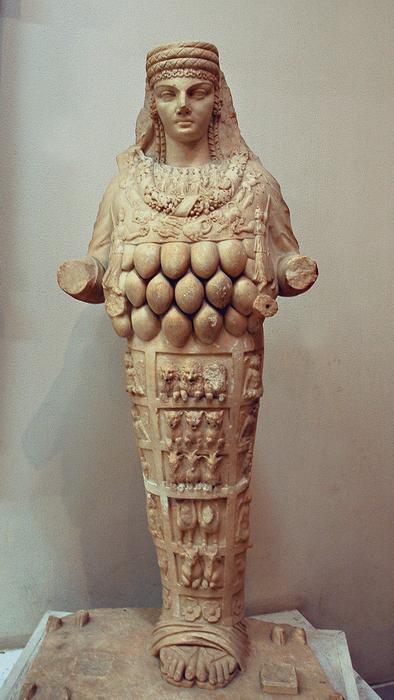
Many of you have probably seen this design before in sculpture or molding. What you may not know (I certainly did not) is that this pattern can be called "egg and dart"; the egg component symbolizes life, and the dagger symbolizes death. The pattern hails from ancient Greece, and specifically belongs to the fertility goddess Artemis of Ephesus. This is not the goddess as the Huntress, but rather as a deity of abundance. Her temple at Ephesus is one of the seven wonders of the world.


To the right is an image of Artemis. My professor actually pulled a reproduction of this statue out of his pocket while he was lecturing. The bulbs on her chest have been interpreted as breasts, eggs, ox testicles, and probably more. The scholarly analysis is that they are gourds, which are a particular symbol of this aspect of Artemis. 
That's what I've got. I just thought you all might appreciate this little tidbit. I also did another video today, if anyone's interested in checking it out.


Thursday

August 27th, 2015

I've been working some more on my YouTube channel the last couple of days. I'm still working on getting all my videos properly captioned, and also just put together kind of a personal introduction.


You would think that I would have made this several years ago, but better late than never. Anyone who's been reading this blog for a while is probably aware of most of the things in this video, but if you're the sort of person who likes hearing the voices of other people, consider checking it out. I talk about my craft, my school, my art, my asexuality, and about some of the neurodivergence I have going on in my head.

Hope everyone out there is having a great week. I've been extremely busy with school, but I'm hoping to relax a little this weekend. Maybe I'll even get some more posts up!

August 20th, 2015

I made another video for YouTube today. It's a little tour of my meditation shrine-altar-thing.


I strive to make my practice as accessible as possible to as wide a range of people as possible. I'm certain that I'm not always successful, but I'm also happy to hear suggestions on what I can do to improve my work. Yesterday, I discovered that YouTube has an option to created closed captioning for one's videos. This would allow hard of hearing or deaf individuals to watch my content, and obviously that's a very good thing. To turn on the captions, you have to mouse over the video so the timeline appears, and then click the button near the volume control which says CC.

The way I've been doing it, I basically have to transcribe everything. This is a quick thing to do for one video, but not so quick when one has 20+ videos that need captions. I have about half of them done now (through 2011, I believe, as well as my most recent two), but I think I'll have to finish the rest some other time, as the joints of my fingers are starting to protest my typing.

Tomorrow I leave for school. We packed the van, and I don't think I'm forgetting anything. Wish me luck!

Monday

August 17th, 2015

After something like three years, I finally made another video for my YouTube channel! Sooner or later, I'd love to start doing how-to videos, or segments on crystals and similar, but today I just walked viewers through my Lughnasadh altar.


I filmed it on my tablet, which took a little getting used to, but after a couple of takes, I think I got the hang of it.