Welcome

Merry Meet, all. Hummingbird, here. 21-year-old eclectic Pagan and witch who works primarily in crystal, warding, and energy magicks. Asexual, with a wonderful girlfriend. I am just beginning to learn the path of Athena. Attending college with end goal of a degree in Interior Design.

This blog is a digitalized record of my life as a Pagan. It includes spells, charms, notes on the properties of various magickal items, and my own personal experiences with my practice. Sometimes I post multiple times a day, sometimes it's once a month.

All are welcome here. Please, make yourself at home, and let me know if I can help you with anything. )0(

Friday

Kiyomizudera

And you thought I was done talking about my Japan trip! ;) Not even close. It does give me a lot of blog fodder, though, so I may stretch it out just a bit.

Otowa-San Kiyomizudera

Literally "Clear Water of Mt. Otowa Temple", Kiyomizudera is another famous Buddhist temple in Kyoto. Founded in 778, before Kyoto was made Japan's capital, the temple buildings have been burned down numerous times. Most of the present buildings were rebuilt by the Shogun Tokugawa in the 1630s. In 1994, it was added to the UNESCO World Heritage list as a historic monument of ancient Kyoto. 
Kiyomizu Temple is a stunning example of Japanese architecture and worship, but regrettably, I only have a few pictures since many of the buildings prohibit photography. 


This is the Deva Gate and primary entrance into the temple grounds. Devas (Ten in Japanese) are Buddhist entities who live on higher planes. They are invisible to the human eye, but those with special extrasensory capabilities may possess the power to hear their voices or see them psychically, or the spirits may take on an illusory form to manifest themselves on the human plane. Their powers include flying and moving from place to place with great speed; the more powerful varieties neither eat nor drink. Under the umbrella term "Deva", there are many varieties of spirit, each having their own abilities and place in the universe. They are arranged hierarchically and in this way could be considered comparable to angelic choirs in Christianity, but a Buddhist would likely caution one to not assume that Devas are equivalent to angels; indeed, some important distinctions exist that one should be aware of. For starters, Devas are not paragons of morality. They certainly can be, and many are, but it is not a requirement. Some possess human vices like arrogance or pride, and likewise they are not omnipotent. Furthermore, Devas are not immortal (though their life span may be billions of years), and they reincarnate just as all other mortal beings do in Buddhist belief. A Deva may come back as a human, another Deva, or something else altogether. It is not easy to work with this brand of spirit, as getting their attention is a challenge, but if they can be contacted they tend to give valuable advice and insight.


Remember the Komainu from Itsukushima? Here's another one, right outside the Deva Gate.


This one is not my picture. It shows the main hall of the temple and the terrace which provides a stunning overlook of the valley and of Kyoto beyond. In this hall is enshrined Kannon Bosatsu (remember her from Kinkakuji?) and I got to see a group of monks performing mass here as well as individuals making offerings and prayers.


This (also not my picture) is the goddess Kannon shown in her form of having 11 heads and 1,000 arms. According to legend, she saw all the misery and suffering in the world but could not answer all the prayers of her supplicants, so her head split into 11 pieces and now she has 11 mouths with which to answer. Likewise, her hands could not offer help to all of humanity, so her arms split apart and now she has 1,000 of them to aid her in her task. The Kiyomizudera statue is hidden most of the time; according to my research, it is only viewable once every 33 years.
The name, Clear Water Temple, comes from the fresh mountain springs which have been flowing since the temple was founded. There are three springs, and patrons wait in a long line to hold a bamboo ladle under the water and drink. Each spring has a different association - longevity, wisdom, and love - but it is generally considered bad form to drink from all three.
I did buy lucky amulets here, of course. One is a small figure of the "god of Business Success", and the other has a dragon printed on the fabric for good fortune.

July 11th, 2014

A couple of months ago, Hazelnut took me to a new metaphysical shop near her house called Gypsy Haven. It's an amazing place, one which I definitely plan to frequent, and also a huge purveyor of crystals. There was too much variety almost to choose from, but I settled on a piece of Black Onyx since I didn't happen to have any yet. Having had some free time today (finally), I felt it prudent to actually get its properties researched and posted.

Onyx

Physical Characteristics: Onyx comes in almost all colors, though black and white are the most well-publicized. The red variety, depending on its composition, is either Sard or Sardonyx.

In Nature: This stone forms from bands of chalcedony in alternating colors and is cryptocrystalline, meaning that its crystal structure is so fine that it is difficult to see, even under a microscope. It forms in vesicles of lava, and consists of fine intergrowths of Quartz and Moganite.

Chemical Composition: SiO2

Mohs Scale Hardness: 7 (middle)

Can be Found: Brazil, Uruguay, Pakistan, Sri Lanka, India, Hawaii, Madagascar

Healing Properties*: Onyx's healing powers are effective but slow. To combat epilepsy, eye and ear problems, unbalanced chakras, and the like, wear Onyx for at least two weeks and up to a couple of months. Cleanse the stone weekly when used in this way. The stone is especially renown for its ability to heal skin ailments. For cases of sunburn, rash, and other topical conditions, use Onyx water (i.e. water that has held an Onyx for a number of hours) to wash the afflicted area throughout the day.

Magickal Properties: According to Greek and Roman legend, Cupid wandered past the sleeping Venus one afternoon, and, feeling mischievous, used his arrowhead to cut the goddess' fingernails. When the clippings fell to the sand, the Fates turned them into the first Onyx so as to let no part of the immortal perish. The name "Onyx" comes from "onux", the Greek word for "fingernail". This legend ties the stone to two powerful deities of love, and yet modern lore states that Onyx will actually reduce sexual desire. Scott Cunningham reconciles this opposition in his Crystal, Gems, & Metal Magic when he points out that as a protective stone, Onyx can be used both ways: to suppress desire when sex could be considered a health risk or to stimulate it by protecting life and the impetus thereof. That aside, Onyx will grant both physical and mental strength and is an aide for releasing attachments to negative people, places, memories, etc. In tandem with Amethyst, the stone is a tool for overcoming alcoholism and encouraging sobriety. Above all, Onyx is famed for its protective qualities, whether that entails keeping negative people out of one's life or warding off danger while driving through a dangerous neighborhood. By virtue of its banishing negativity, the stone is a confidence booster as well as a stress reliever. Use the stone in banishing rituals, or as a tool of divination; in particular, it is an excellent scrying stone. Other magickal uses include psychic contact with the deceased, mediumship, and past-life regression. In Chinese Feng Shui, the color black is associated with wealth and wisdom; left in an office, Onyx will assist its bearer in making wise business choices. Onyx is noted for its tendency to store the energies of its owner. This is a good thing for its bearer, as it creates a close working tie with the stone, but should one receive Onyx as a gift, be sure to thoroughly cleanse the stone of its old energy.

Chakra Association: First (Root) Chakra. Also the Second (Sacral) and Sixth (Third Eye).

Element: Fire
Energy: Projective

Planetary Association: Mars

*Magickal healing should never take the place of seeing a doctor and following any recommended prescriptions, actions, or other advice. Magick works best in tandem with physical efforts, anyway, so don't skimp on those check-ups!

Thursday

Litha Altar

It's a bit late now for pictures, I suppose, but I did want to share some insight into my Litha altar from earlier this month because it highlights a couple of new design elements.


If you're familiar with how I usually lay out my altar, it's pretty immediately obvious what one of those changes is - I've got my BOS moved over to the left side instead of centered. I actually don't like that as much, because it feels a little off-balance to me, but I just bought the navy blue altar cloth at Kinkakuji in Kyoto, and I didn't want my binder covering up the design. Naturally, it got covered up anyway. Go figure.


I also bought this little guy in Japan - he's my new (read: only) crystal ball. In actuality, I'm reasonably sure the ball is glass, but it works as a focus point, and it's being held by a precious little bunny, so how could I refuse?


And then there's this. I mentioned it a few posts ago, but this is a (bad) picture of my new chalice from Aunt C. It's hard to tell with the poor lighting, but it has a purple triple moon symbol on it with a triquetra in the middle.


Finally, this little guy is a Daruma doll. I'll probably blog more extensively about them later (especially if and when I use it), but in essence, one paints a single eye black and makes a wish, and then paints the other eye when the wish is fulfilled.

July 3rd, 2014

Kinkakuji Temple

Kinkakuji is a Zen Buddhist temple located in Kyoto, Japan, and was founded in 1397. The original building was burned down during the Onin war; in 1950, it was burned down again by a monk later diagnosed with schizophrenia and a persecution complex. The present structure was rebuilt in 1955, and is one of the most famous temples in the island nation, attracting huge numbers of tourists annually. The name "Kinkakuji", translated as "Golden Pavilion", comes from the exterior of the temple itself, which is coated in a layer of gold leaf. The gold is used as a purifier of the worshippers, mitigating pollution in the soul and negating unhealthy attitudes towards death. Beyond the beauty of the building itself, the temple is noted for its extensive gardens, which are considered an excellent example of the Muromachi design style.

The Pavilion is sacred for a number of reasons. For one, it functions as a "shariden", holding the Buddha's ashes. It also houses a hall of worship for Kannon Bosatsu, the Japanese goddess of mercy. Known in other Buddhist sects as Avalokiteśvara, or "The God Who Looks Down", Kannon is a Bodhisattva embodying the compassion in all manifestations of Buddha. According to Mahayana doctrine, this Bodhisattva has sworn to refuse its own Buddhahood until all sentient beings have achieved Nirvana. 

Wikipedia (because nothing on that website is ever wrong //sarcasm font//) lists the Japanese mantra to Kannon as "おん あるりきゃ そわか" or "On Arurikya Sowaka".


The temple. The building is not actually open to visitors so far as I could tell (I think it's open only to monks), but there's a boardwalk all around the lake, and plenty of opportunities to make donations and pray outdoors. 


The phoenix roof ornament with a crow sitting on top. Japanese phoenixes have the same essential meaning of life and rebirth that they do in other parts of the world.


Me with the temple - proof that these aren't just photos from Google Images.


At all the shrines and temples we went to, the expectation was that one would donate some small amount of money (usually the equivalent of a dollar or less) before praying. Here, the most powerful prayers are those where the visitor's coin lands in the little metal bowl. As my history teacher put it: "Buddhists were the original capitalists".
At this temple, I bought a safe travel amulet, as well as a wooden bracelet for my uncle (it seemed like the sort of thing he would wear) that is supposed to convey good health.

Monday

June 23rd, 2014

I do want to write up posts about my time in Japan, but first, a bit of news from today. My family and I are spending the weekend at my chosen university for next fall, going through the whole freshmen orientation business. The campus is set in a beautiful landscape, mere minutes from a wildlife refuge, national forest, and a park that's actually called Garden of the Gods. Not only that, but five minutes from my dorm is a Gaia Interfaith center, and there's a forest preserve in the middle of campus. It couldn't be a more ideal setting for a Pagan (well, other than no candles or incense in the dorm room). Moreover, there's a ton of diversity in the student body, so I can't imagine I'll be the only Pagan in the area. Like the icing on the cake, we were taking a bus tour this afternoon when we passed the campus forest preserve and saw a doe standing along the edge of the trees. She looked right at me, and I knew that could only be a sign of Goddess-given approval. I can't wait to start here in the fall!
Okay, back to Japan. The first shrine we visited was Itsukushima Shrine on Miyajima Island, across the bay from Hiroshima. 

Itsukushima Shrine
Itsukushima is one of the most famous shrines in Japan, and is listed as a UNESCO World Heritage site. Because it is a Japanese shrine, it is Shinto. Japanese temples are Buddhist. That being said, Shintoism and Zen Buddhism coexist peacefully on this island nation, and indeed, over 70% of the population considers itself both Buddhist and Shinto. Many famous places are actually home to both temples and shrines in the same acre of space. As a general rule of thumb, Shinto rites relate to one's daily life, while Buddhist rites deal with death and remembrance of the deceased. In Shintoism, the color white is considered sacred. Many paper temple decorations are white, as are the robes worn by the priests.
The shrine celebrates the god of the island itself, specifically the god (kami) of Mt. Misen, the island's tallest mountain. That being said, there are websites which say that this shrine venerates Susanoo, the moon and storm god, his daughters, or various local goddesses. I am basing my information off what was listed on the UNESCO website, given that that seemed like the most reliable source of information.
Itsukushima was supposedly founded in 593, but no written record of it exists prior to 811. The original buildings were reconstructed and expanded in the 1100s (1168, according to written record), after which the shrine received the patronage of Taira no Kiyomori, the most powerful shogun of the era. He believed he owed his political power to the god of Itsukushima, and worshiped there often. As a result, some Japanese may consider the place a shrine to Kiyomori as well.
Fire severely damaged the premises in 1207, but reconstruction efforts kept the blueprints very similar to what had been there in Kiyomori's time. Since then, the shrine has never been reconstructed all at once, but individual buildings have required work as storms, typhoons, and tsunamis have done damage. They have been meticulously repaired in accordance with historical materials and practices. The Japanese government now personally oversees work done on this historical religious site. A relatively recent addition? Fire extinguishers, since Itsukushima is built entirely of wood and plaster.
But enough history. It's the pictures that you actually want to see.

Here's your first view of Itsukushima as you approach Miyajima by ferry. That vermillion Torii gate is not the shrine itself, but it is the gate of purification that designates the presence of all Shinto shrines. This one is particularly impressive - for one thing, it's huge. For another, it's set well out on the beach such that it appears to float on the water at high tide. In ancient times, pilgrims could not enter the island until they had passed under the Torii by canoe and ritually cleansed themselves.


Also on the island, besides the shrine, are dozens of these cute little deer (Yes, that's me next to him. Pictures or it didn't happen, right?). They're considered a Japanese national treasure, and are denizens of the shrine in their own right. Being completely used to human presence, one can walk right up to them, and they'll just keep on minding their own business. You aren't actually supposed to pet them (a rule that doesn't seem especially well-followed), but if you have so much as the slip of a paper receipt showing, they will try to eat it. Go figure.


This is a Komainu, a "lion dog" spirit always displayed in pairs and usually at the entry gates to Shinto shrines. Originating in China, Komainu spirits and their statues are found today in Korea and Japan as well. Lions are mystically believed to frighten away evil in the East, and so they sit and guard these sacred spaces. In many pairs, the animals are identical but for one thing: their mouths. Often, one will have its mouth open and the other's will be closed. The open-mouthed spirit is saying "A", the first letter of the Sanskrit alphabet, while the closed-mouth spirit says "Um", the last letter. Together, they say "Aum", representative of the beginning and end of all things (think Alpha and Omega); the word has significance in Buddhisn, Hinduism, and Jainism, but is relevant to cultures the world over.


This is a much closer view of the Torii gate; note how small the people are by comparison. Leave a coin at its base and make a wish.


These are the handwashing stations which can be found outside all shrines and some temples. The proper way to use them is as follows: holding the dipper in your left hand, scoop a cup of water and pour it over your right. Switch the dipper to your right hand, and pour water over your left. Then cup your left hand and pour water into it. Sip this water and use it to rinse your mouth; then spit it out onto the bamboo or rocks outside the water enclosure. Finally, allow the remaining water to run down the handle of the dipper to clean it for the next person. This represents purification of the body, while passing through the Torii gate is purification of the soul.


And finally, the shrine itself. Inside, one can walk the corridors in quiet contemplation, pray as desired, marvel at the tiny crabs inhabiting the sandy courtyard at low tide, and if you happen to make it at just the right time, watch a Shinto priest perform a ceremony. Available for purchase are paper fortunes (better than fortune cookies) in a variety of languages - English, Chinese, Japanese, and Korean are the usual ones - or Omamori, which are lucky amulets. These come in a wide variety of colors and meanings, and each can only be bought at that specific temple or shrine. They are often monogrammed, at the very least, with the name of where they were bought and with their purpose. From Itsukushima, I got a purple amulet (or in this case talisman might be more accurate) to enhance studying and a pastel one embroidered with island deer for general good fortune.
That's Miyajima! If you ever have the opportunity to go, I highly recommend it. It is absolutely stunning, not to mention of vast historical, cultural, and religious significance. I can also tell you that the maple leaf is an iconic symbol in the Miyajima area, and that you can not only see many wild Japanese maples (Momiji) but you can also get lots of maple leaf themed snacks and souviners. Yes, I shopped more in two weeks than I've done in my entire eighteen years. No, I do not have a single regret.

Sunday

June 22nd, 2014

Well, I celebrated Litha on time, even if my posting about it isn't. Yesterday was the first day of summer, solstice, and longest day of the year. I completely redecorated my altar earlier in the week, developing a new style to incorporate a fancy metal chalice, which was a graduation present from my Aunt C, and several of the things I bought in Japan. Yes, Japan! I finally got to go!
We left on Wednesday, May 28th, and stayed through June 11th. Among other memorable activities, we visited several temples and shrines, each of which will warrant their own post, and I bought a number of amulets blessed at these shrines as magickal souvenirs. It was an amazing trip.
Before I left, I put together a little travel-safety amulet of my own. I'll share it here, in case you're looking for a quick and inexpensive spell for before an extended journey or vacation.

Hummingbird's Travel Amulet

Begin with a small drawstring bag. Have on hand a handful each of rose petals and lavender, a piece of turquoise, and a small representation of a bird (if traveling by air), a fish (if traveling by sea), or a horse (if traveling by land), either as a photograph, drawing, or other token.
Then, cast a Circle and cleanse all the items with holy water. Individually empower the items as follows:
- Rose petals: positive relationships between your party and the people in the region you are visiting (rose is an herb of love, after all)
- Lavender: general calm and peacefulness throughout the trip
- Turquoise: safety in travel (a property for which this stone is well-known)
- Animal token: to guide you there and back again
Put all the ingredients in the bag and say a final blessing over it. This could be as simple as presenting the pouch to the elements and Spirit and asking their respective blessings. When you've finished, pack the amulet in your luggage. The best part? The herbs make your clothes smell good.
As per the usual, any of these ingredients can be freely substituted to tailor the spell to your specific needs. If you have any particular worries about the trip, you may add a token to solve them. If you think you may use my spell, send me a comment. I'd love to hear what you thought of it!

Friday

April 25th, 2014

Yes, I have an excuse for not posting. No, that doesn't make it okay. But between my last senior musical, directing a one-act play, and preping for graduation, perhaps you can understand why I haven't done much blogging lately. (Fanfiction might also have something to do with this, but you didn't hear that from me.) We went to the zoo a month (or two) ago, and I bought me a piece of Dalmatian Jasper, so I thought it might make a good apology to blog about that today.
 
Dalmatian Jasper

Physical Characteristics: Jaspers appear in a multitude of colors according to the content of the sediment they form in, and are also affected by the presence of other minerals, volcanic ash, etc. Dalmatian Jasper, because of its coloration, is often dyed and may be sold as fake Turquoise or other spotted stones.

In Nature: Jasper is an opaque variety of chalcedony, and is likewise an impure silica (that makes it a Network Solid, for all you AP Chem students!). In this particular variety, my research on the internet suggests that the black spotted inclusions are actually pieces of Black Tourmaline, but I do not know that for a fact. If anyone has more information, please feel free to comment.

Chemical Composition: SiO2
 
Mohs Scale Hardness: 6 - 7 (middle)

Can be Found: America, India, and Mexico are the only sources I found cited on the internet, but I'm sure it's more common than that. Again, there seems to be rather a dearth of information.

Healing Properties*: In healing magick, this is a stone to boost the immune system and clear toxins from the body. It is said to aide disorders of the bowels, benefit the muscles, and prevent sprains. Because of its tendency to improve the mood, it may help those suffering depression or those trying to quit smoking.

Magickal Properties: A subspecies of Brown Jasper, this is a nurturing, protective stone. It is also a stone that assists in the manifestation of one's ideas and goals, and could feasibly be useful to an entrepreneur, a student, or even a first-time home buyer. The stone grounds, absorbs atmospheric negativity, and inspires tranquility while reducing geopathic and environmental stressors. The stone's spotted pattern associates it with the animal kingdom, especially the dogs for which it is named, and may be particularly useful when working with your pet or helping children overcome a fear of animals. In the home, Dalmatian Jasper strengthens family ties, encouraging fidelity and emotional harmony. Children may be additionally aided by it as a ward against nightmares. This crystal breaks illusions and is an all around "pick-me-up" stone. Interestingly, Ancient Europeans and Native Americans alike used it to summon rain.

Chakra Association: First (Root) Chakra

Element: Earth

Energy: Receptive

Planetary Association: Earth, according to what I've read. I've never heard of an Earth planetary association before; usually, it's only elemental. Nevertheless, that's the impression I have at this time. Brown Jasper has a Saturn association, so that could also be appropriate.

*Magickal healing should never take the place of seeing a doctor and following any recommended prescriptions, actions, or other advice. Magick works best in tandem with physical efforts, anyway, so don't skimp on those check-ups!

Sunday

March 30th, 2014

So I never posted pictures of my Ostara altar, and I thought I should remedy that before the month is out:


As usual, the lighting was not cooperating, but what can you do? I also took a picture of my shrine, which is set for general use and is currently housing a bunch of birthday cards as a sign of gratitude.


And finally, here's a close up of the card from my grandparents, which I thought was too quintessentially Pagan to be ignored:


For the first time all spring break, it's actually warm outside, and I have my windows open for the first time in 2014. It's so nice to have sun, heat, a gentle breeze, and the sound of windchimes all at once. Here's to spring!

Saturday

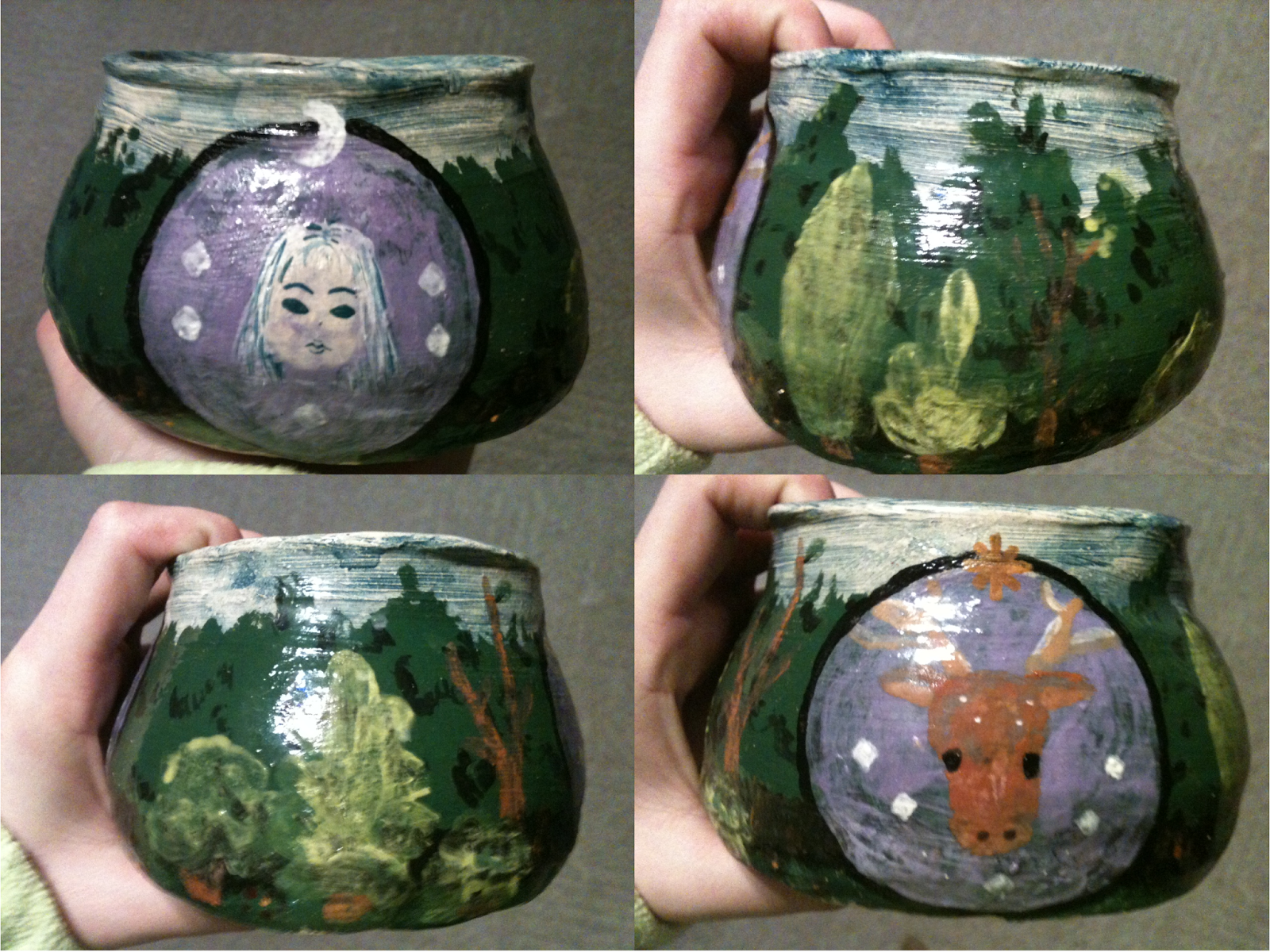
Pagan Bowl

A few weeks ago, I threw a bowl on the potter's wheel in my Ceramics class for fun and ended up using an underglaze technique to paint it at my teacher's recommendation. What's nice about underglazes is that you can layer them and mix them exactly as you would regular paint, but it can be fired and made food safe. I ended up painting a sort of Pagan forest scene on it.


March 15th, 2014

Well, I already know I'm not going to have any time next week to make my Ostara posts, so I'll do it now, yes? I mean, let's see:
  • Sunday: Teaching Sunday School (so much irony), work
  • Monday: School, rehearsal, work
  • Tuesday: School, rehearsal until 8:00
  • Wednesday: All day rehearsal, more rehearsal, work
  • Thursday: School, rehearsal, work, MY BIRTHDAY, Ostara
  • Friday: School, rehearsal until 7:30, parent night
  • Saturday: All-day acting competition, theoretically going out for the birthday dinner I'm not getting Thursday...
I think that paints an accurate enough picture of my schedule. That's not even accounting for homework time. But enough about me. I mean, gosh, you'd think this was, like, my blog or something.

Today being the first weekend in months that I haven't had homework, I finally had a chance to power-clean my room. Ever since winter break, I've been home so little that I just had college mail piling up in corners with books and art pieces, two baskets of clean laundry waiting for me to put them away, a terribly made bed, dust all over, ceramic pieces I've made without a proper home, and on top of all that, my poor altar and shrine were still set for Yule. It feels so much better to have everything in order - I jest you not, there is a physical difference in my stress level right now. Cleaning gets rid of negativity, of course, especially since dust hangs on to it, but it also looks way nicer.
After cleaning my room, I got down to the business of fixing my altar. I got out all of my Ostara decorations (plastic eggs and silk flowers, mostly) and got the Yule stuff boxed up at last. My little brother came in as I was working on it, and he just sort of stared for a moment before saying:
"Is that all you do to make a living, besides work? Decorate your closet?"
I just laughed. He thinks it's so bizarre that I change my decorations every other month or so.
Suffice it to say, it's overwhelmingly pleasant to be caught up. Now if I could just find the motivation to sew the buttons back on my coat...