Wednesday
June 27th, 2012
My youngest brother, Ben, has day camp three days a week, and mom has convinced Nick and I to go for a half-hour walk with her in the mornings while he's gone. We've been going to a local forest preserve, walking the trails for several weeks now. Today we went again. Sometimes, we see a great deal of wildlife (on Monday, mom found a wee baby turtle!), but today was looking pretty quiet. On our way back, however, we spotted a bluebird, which Nick tells me is rather rare around here, as they eat fruit. Therefore, they can be hard to find around suburbia, where fruit-bearing bushes are rare. How wonderful, to see those turquoise feathers!

Sunday
June 24th, 2012

The following day, we went canoeing. Because the Creek was low, we had to drag the canoe in many places, but we still got in plenty of paddling; my shoulders will be sore for several days. The shallow water did have its advantages: we could see all the fish in the Creek. There were thousands of tiny minnows, as well as bigger carp, bass, and some kind of gar or pike. Nick spotted a turtle (not to mention all the frogs and toads), and we spent probably 80% of the trip following a trio of herons, who would fly 50 feet or so, wait for us to catch up, and then fly on again. Nick laughed when I suggested that maybe they were leading us back to camp, but I don't think it was that ridiculous an idea; twice, the Creek split, and we couldn't tell which way to go. Both times, the herons flew the direction we needed to head, and we discovered later that the other fork just led to a blocked area. Perhaps it would have been passable on both sides if the water was higher, but that day, the herons definitely knew what they were doing. And according to Native American tradition, the heron is regarded as having good judgement, as well as being a source of wisdom. I think I was not as far off base as Nick may have believed. Later, we canoed past an entire flock of turkey vultures, saw some kingfishers, and discovered some cool fossils.

We got back on Saturday. I'd wanted to stay longer, as the park sported a few posters advertising a party that was to be held in honor of the park's 60-year anniversary, complete with Native American music and drum circle. Unfortunately, we had a schedule to keep, so sticking around wasn't possible. Since my return, I've largely been focusing on re-reading some old favorites and doing summer homework. I couldn't be more thankful for this opportunity to see some of the goddess' finest natural beauty. Have you gone on any exciting vacations this summer?
June 17th, 2012


Tuesday
June 12th, 2012
Strange things happen sometimes, and I for one do not believe in coincidence. Yesterday, after typing up the information about this Celtic Tree Month, Oak, my mom, Nick, and I went on a half-hour hike at a local forest preserve. It was almost time to turn around and head back, when we came upon a place where the trees hung over the path and formed a tunnel. Nick declared that it was a "portal to another world", and said that we must go through it. We did so, and nothing out of the ordinary seemed to happen. However, turning back, I looked up and realized that the trees creating the tunnel were varieties of Oak. I was instantly reminded that the Fey protect Oaks, and wondered for a moment if Nick's claim that the tunnel was a portal was as far-fetched as it seemed. Then later, my dad said, totally out of the blue, that if something were to happen to one of the trees out front, he would replace it with an Oak tree. I feel as though I am being told something here....

~~~~~~~~~~
In other news, mom and dad decided to take a vacation this summer - we're going to Niagara Falls! We will go hiking, and also take the Maid of the Mist boat out to see the falls up close. Naturally, the Native American tribes who once lived in the area had legends about the falls, and indeed, the name "Maid of the Mist" comes from that folktale.
The Ongiara people had lived peacefully along the falls for many years, when suddenly, many villagers began to sicken and die. The people thought that they had angered the thunder god Hinum, so they began to send canoes of food over the falls in offering to him. When that failed to stop the sickness, the chief's daughter, Lelawala, was to be sent over instead. As she fell over the edge of the waterfall, however, the sons of Hinum caught her, and wished to marry her. Lelawala agreed, on the condition that she be allowed to tell her people how to save themselves from the sickness. The youngest son told her that it was not Hinum's anger killing her people, but rather, a great water snake that was poisoning the water, and then eating those who had died. Lelawala was then allowed to appear to her people as a spirit, and tell them of the terrible snake. The villagers hunted it down and killed it before it could do the people any more harm. The river swept away the body, and Hinum turned the snake's remains into the Horseshoe Falls segment of Niagara. Henceforth, Lelawala has reigned in the cave behind the falls as the Maid of the Mist.
I am not yet sure, but I think that we are to hike to the cave behind the falls, and if so, I should like to pay homage to Lelawala, who, after her marriage to the youngest of Hinum's sons, became a goddess of the Ongiara tribe. She is said to wear a white doeskin robe, with a wreath of flowers in her hair.

Monday
June 11th, 2012

The Oak month is Duir in Celtic, and may have meant "door". Many scholars theorize that Duir was the root word of Druid. The Oak is a tree or shrub in the Quercus genus, and has about 600 different species. Oak is native to the northern hemisphere, and can be deciduous or evergreen, ranging from temperate climates to tropical. The flowers are catkins, and the fruit is the omnipresent acorn, also known as a cupule.
In Greek mythos, the oak is Zeus' sacred tree, and at his oracle in Dodona, an ancient oak forms the temple's central structure. The priests of Zeus would interpret the god's word by listening to the rustling of the oak's leaves. In Baltic mythology, that is, the myths of the Lithuanian region, the Oak is sacred to Perkons, god of thunder, like Zeus to the Greeks. Even the Celts followed the relation to thunder - Taranus, the thunder god, was associated with the tree. The Norse continued the association: Thor's tree was the Oak. Some scholars speculate that this was because the Oak is the largest tree native to Europe, and therefore was most frequently struck by lightning. Regardless, the Oak has a strong connection to the weather, particularly storms.
In magick, the Oak is an extremely versatile wood. It can be used in spells for strength, prosperity, good fortune, fertility, money, and success. According to legend, catching a falling Oak leaf before it touches the ground ensures good health in the coming year. Also, and acorn carried in the pocket will bring success to a business meeting. The ashes from a burned piece of Oak will protect one against lightning and fire, although on the other hand, Oak could be used to draw a storm during drought. The burning of the leaves has a purifying effect, and can be used as an alternative to incense. Oak is also closely tied to masculinity, making it a traditional wood for carving masculine tools: the athame, staff, etc.
*A note to the wise: Oak, like other trees, is said to be the home of the Fey. Oak is a powerful and sacred tree, so any wood, leaves, etc. taken from a tree must be repaid with a sacrifice of some kind. Water and/or natural fertilizer is a good place to start, but tokens such as hair, stones, etc. are also acceptable.
Acorns make excellent snacks, although other parts of the tree are less edible. The White Oak in particular provides acorns that may be sweet enough to be eaten raw. (The White Oak can be identified by the rounded edges of the leaves.) However, the acorns can also be boiled or roasted, then dried. As such, the acorn can be eaten like a nut, dipped in syrup to make candy, or ground into flour. Acorns contain natural, healthy fats, and are rich in protein.
Wednesday
June 6th, 2012
Summer vacation officially began the afternoon of the 4th. Since then, my brothers and I have been kicking back, enjoying the weather. On Sunday, mom thought it would be nice to go out for a while, so we drove to a heritage farm about 20 minutes from our house. We saw their new calves (a few months old, I believe) and a horde of baby piglets that were born on the 29th. They were really tiny, maybe the size of your hand. We hiked through the surrounding nature preserve, and saw wild turtles and frogs, plus several enterprising chipmunks. Indeed, we had just arrived at the preserve's visitor's center when one chipmunk, in search of food, was tackled by a second chipmunk that lept from the trees like a crazed Tarzan. Nick spotted a Baltimore Oriole, a bird species of high interest to him, and I purchased an arrowhead at the visitor's center. I don't believe it was particularly old, but cool nevertheless. In other news, I got my Litha altar set up, and will theoretically be making a video soon.
Friday
May 25th, 2012
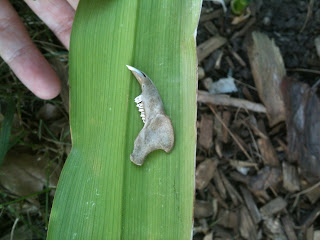
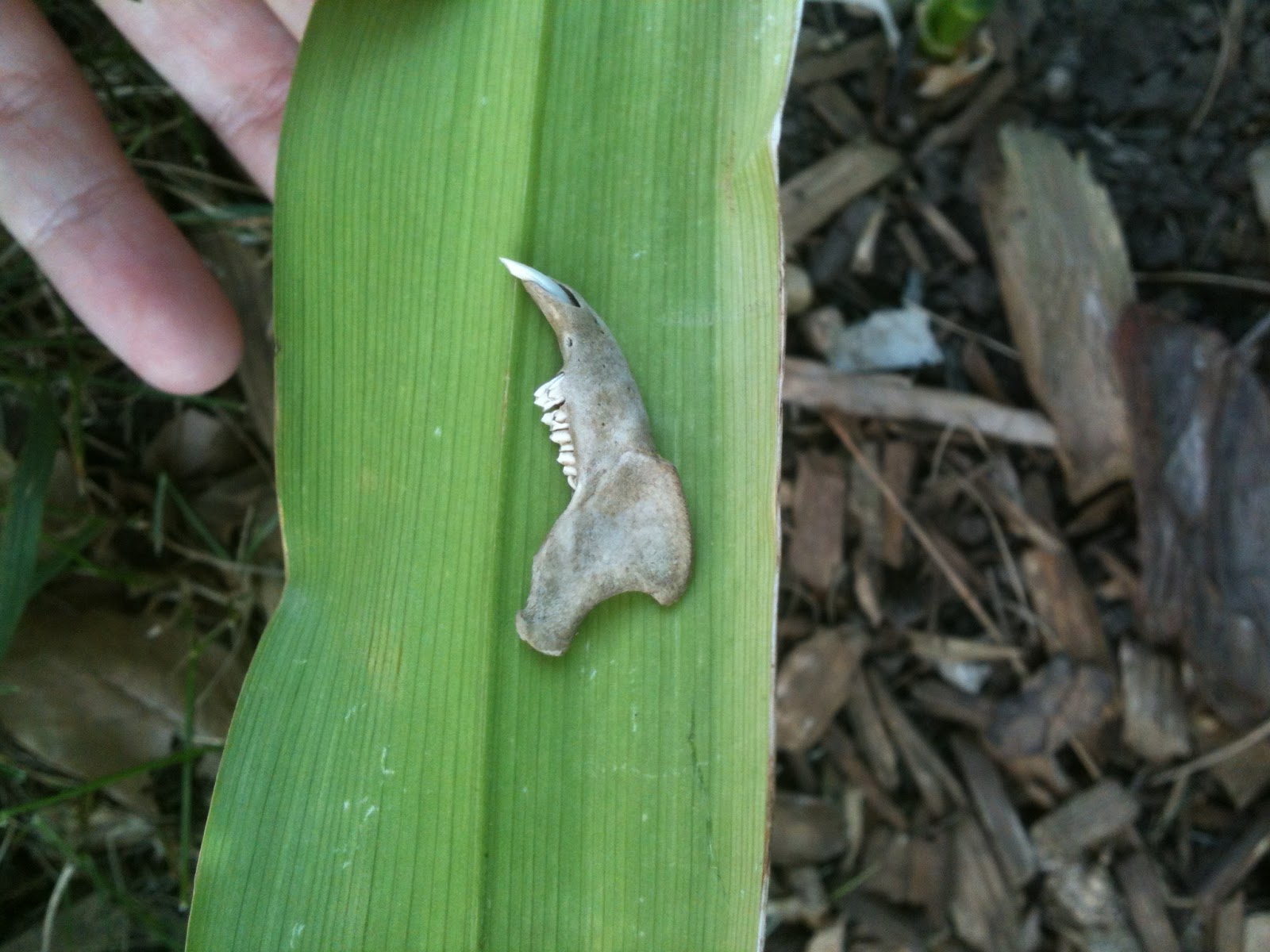
What an exciting couple of days it has been! Yesterday, my chemistry class tie-dyed our clothing articles (most people had shirts, but some used pants, and one boy did his socks). I had a tank-top, which I colored in a green and blue spiral pattern. It's in the wash as I type this, and it looks like it came out great! Also, because the weather was so fantastic yesterday, I went and sat out in the yard. We have a trellis with wisteria growing over it, and the plant has gotten so huge it casts a wealth of shade around said trellis. Therefore, I sat in the shade, enjoying the wind (which was strong), when I happened to look up. And there, lo and behold, in the crook of a lily and a leg of the trellis, was a little skull. Yes, a skull. It was just over a centimeter long, fully intact, although without the lower jaw, and clearly that of some rodent - it had large buckteeth. I called Nick, the resident animal expert, over, and he was able to confirm my suspicion, telling me that the skull was definitely that of a rodent, and that judging by the large eye sockets, the creature was nocturnal. His best guess, therefore, was that it belonged to a rather unfortunate rat. On some level, I wanted to keep the skull, and yet, as fascinating as it was, I decided that not only was keeping it a bit unhygienic, but the skull also belonged outside, where I found it. I put it back, and left it to guard the property. Today, I went back out to try and get some pictures, but the skull had disappeared! (I suspect Nick may have had a hand in this) However, I still went and poked around a bit, and, to my surprise, I found not the skull, but half of the missing jaw, and another piece of anatomy I couldn't identify. There was also some fur buried under the wood chips which may have belonged to the creature. Most mysterious...
Monday
May 21st, 2012
What with all that planting yesterday, the first sunburn of the summer is setting in... My shoulders have been a little too warm for comfort all day. Ah well. In any event, some interesting developments today. I woke up and looked through the window to see a great big opossum trundling thorough the back yard. Now, not everyone likes opossums, but personally I think they're alright, and seeing one always seems to have positive connotations. Indeed, other than the sunburn, today was actually the best weekday I've had in a while. The opossum is also said to represent emotional and mental stability, which I will take as a good omen. Recently, I've been a little too stressed for comfort, and if the opossum represents a reprieve from that, I'll certainly take what I can get! Plus, my video that I had to make for English actually played on the old school computers, which was an untold relief (those things are seriously ancient).
 With all said and done, I'm looking forward to a nice, quiet evening with the family tonight. Mom says we're having chef salad for dinner: various greens, cheese, peppers, ham or turkey, tomatoes, carrots, and croutons. A salad makes a great meal or side dish this time of year - so many veggies are just coming into season! Buy locally if you can, and make sure to rinse everything before you eat it to get rid of any pesticides or dirt. Try eating greens with dark leaves, like spinach (which, by the way, goes very well with some feta cheese and strawberries). Vegetables not your thing? Fruit salads taste equally awesome. Any combination of tropical fruits (bananas, mango, pineapple, papaya, star fruit, etc.) and more temperate fruits (grapes, apples, strawberries, blueberries, etc.), plus a sweet, unifying dressing contains valuable nutrients as well as citric acid and a great summer flavor. One could even make a refreshing snack, if one were to blend together some ice, orange juice, bananas, and mangoes. Are fruit smoothies awesome? I think so. The moral of the story? Enjoy the turn of the Wheel to the summer months by enjoying the fresh produce of the season!

Sunday
May 20th, 2012
You remember how I thought that after finishing with the musical I'd have a little more free time to write posts and whatnot? HA! I had no idea at the time that I would be getting a 740 point English project and a 400 point marketing project, along with the AP World History test and finals all in the last three weeks of school. Oh, plus the math project I'll be getting after the final. So suffice it to say, this is literally the first bit of free time I have had since my previous post.


The bonfire grate. I love how pretty it is with the bright green foliage around it.

A wee wild violet growing in Hazelnut's yard:

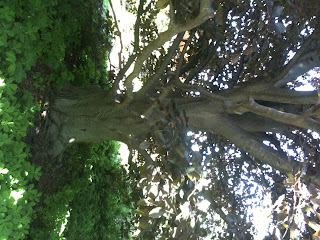
For Mother's Day, my family went to the Morton Arboretum. Here was one of the trees:
In the children's garden, there were fairy statues hidden in some of the trees. Well, you know how I am with fairies!

I believe these were some kind of a Japanese Cyprus, but I could be misremembering.

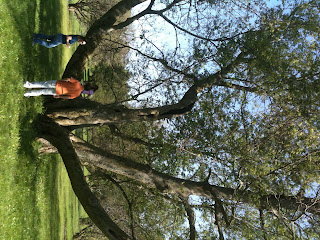
The trunk on this one is wicked:
Cute little pansies:

There was a huge mess of peonies. And they were so fragrant:

The whole family spent today and yesterday expanding and planting the vegetable garden. We have chives, tomatoes, various salads, corn, watermelon, carrots, cucumber, and onions. I made the fence myself. :)

~~~~~~~~~~
In spite of all the craziness, I've been up to some interesting things this month. The first weekend of May (the 5th, I believe), I went to Hazelnut's house. It was her year and a day, so after spending some time outside, going to an awesome drum circle, and making s'mores around a bonfire, we did her dedication ceremony. Congratulations to Hazelnut, an official member of the Craft!
- While we were outside, Hazelnut spotted a curious little butterfly who
was more than happy to crawl onto our fingers. Here it is with me:

And with Hazelnut:

Certainly not a camera-shy butterfly:

The bonfire grate. I love how pretty it is with the bright green foliage around it.

A wee wild violet growing in Hazelnut's yard:

For Mother's Day, my family went to the Morton Arboretum. Here was one of the trees:

In the children's garden, there were fairy statues hidden in some of the trees. Well, you know how I am with fairies!

I believe these were some kind of a Japanese Cyprus, but I could be misremembering.

The trunk on this one is wicked:

Cute little pansies:

There was a huge mess of peonies. And they were so fragrant:

The whole family spent today and yesterday expanding and planting the vegetable garden. We have chives, tomatoes, various salads, corn, watermelon, carrots, cucumber, and onions. I made the fence myself. :)

May 13th, 2012

In mythology, the Hawthorn is a symbol of hope; the Greeks used it in wedding procession, and those branches that are in bloom by May 1st may be used in Beltane rituals. Even in Christian lore it is rumored that Jesus' "crown of thorns" came from the Hawthorn tree. In Croatian lore, it is the wood of the Hawthorn, sharpened into a stake, that can kill the vampire, and the tree has an exceptionally strong tie to the Fey. Don't hurt the tree, or they will find you!
In magick, the tree has many uses. The Celts used Hawthorn wood for rune inscriptions, and a piece of cloth tied to the tree branch as an offering will bring healing. Also, since the tree is in flower at Beltane, it is tied to the raw masculine side of fertility, and the element fire. One hoping to conceive will find the Hawthorn month profitable, and using the wood in a fertility rite will help usher forth results. Since the tree has such a strong connection to the Fey, using it with other woods sharing that energy, Apple and Oak in particular, can call the faeries into circle.
The fruits of the Hawthorn are indeed edible, and are made into a host of spreads: jaws, jellies, etc. They can also be made into wine; however, the berries are rarely eaten raw. The flower petals are likewise edible, and early in the year, the leaves are tender enough to make a salad.
Subscribe to:
Posts (Atom)